You all know that dissemination of research has been changing rapidly in recent years. Publishers, funding agencies, professional societies, educational instititutions, and others are stakeholders in how best to shape the future of this process. Libraries and librarians have long been intermediaries in this process, and are active participants in the discussion. Create Change is a website advocating for using the benefits of technology for wider access to the fruits of your labor. It also gives examples of initiatives in open access scholarly publishing from many fields of study.
From the About page of the Create Change site:
"Create Change is an educational initiative that examines new opportunities in scholarly communication, advocates changes that recognize the potential of the networked digital environment, and encourages active participation by scholars and researchers to guide the course of change.
"Create Change was developed by the Association of Research Libraries (ARL) and SPARC (Scholarly Publishing and Academic Resources Coalition) and is supported by the Association of College and Research Libraries (ACRL)."
Thursday, June 22, 2006


Tuesday, June 20, 2006
Lost in a sea of science data
A free article from the Chronicle of Higher Education describes how librarians are teaming up with scientists to archive and preserve huge amounts of scientific data:
Science is experiencing revolutionary changes thanks to digital technology, with computers generating a flood of valuable data for scientists to interpret.(read entire article)
But that flood could drown science.
Data from experiments conducted as recently as six months ago might be suddenly deemed important, but researchers might never find those numbers — or if they did, might not know what the numbers meant. Lost in some research assistant's computer, the data are often irretrievable or an indecipherable string of digits. That's a scenario increasingly familiar to scholars, says James M. Caruthers, a professor of chemical engineering at Purdue University.
"We are starting to die from data," he says bluntly.
To vet experiments, correct errors, or find new breakthroughs, scientists desperately need better ways to store and retrieve research data, Mr. Caruthers says, or "we are going to be more and more inefficient in the science that we do in the future."
Dealing with the "data deluge," as some researchers have called it, will be among the great challenges for science in the 21st century. Many in the field say that scientists should not be left to manage the data on their own.
Instead, librarians will have to step forward to define, categorize, and archive the voluminous and detailed streams of data generated in experiments. Already, librarians on some campuses — among them Purdue, the Johns Hopkins University, and the University of California at San Diego — are beginning to take on that role.
Art of Science Competition / 2006 Gallery
Check out some really striking and lovely images and video from Princeton University's 2006 Art of Science competition....I especially liked this one:

Color Patterns of an Iron Extraction Time Series, Andrew Altevogt, Department of Civil and Environmental Engineering
More about the Art of Science competition.
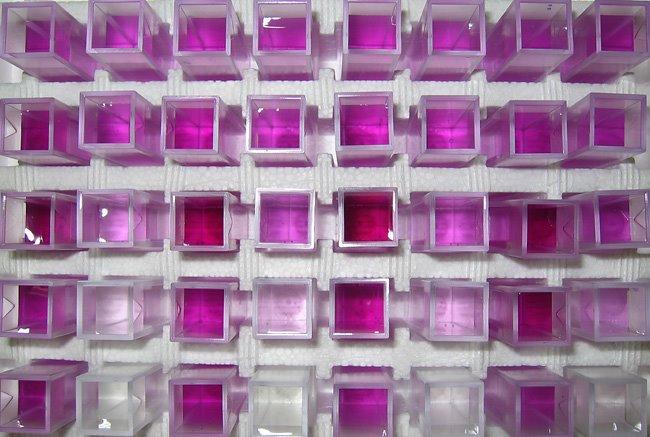
Color Patterns of an Iron Extraction Time Series, Andrew Altevogt, Department of Civil and Environmental Engineering
More about the Art of Science competition.
Thursday, June 08, 2006
Technology in Geologic Time...
I have a copy of my Geology MS thesis on a 5" floppy disk, which I carefully copied and coddled while I wrote (and rewrote and wrote and rewrote) my masterpiece. Now I might as well use it as a coaster for my double half-caf skinny latte. The era of the 31/2 disk is also well and truly over, I'm told. Are CDs and flash drives far behind? So if every new technology is doomed from its inception, how do we preserve our data for future scholars, or even for our own future projects? This concern is raised in stlq, one of my favorite blogs. Fortunately, UMass is working on a solution-- a digital repository, tentatively named UMass Scholarly Commons. For examples of other universities' digital repositories, look here. Aside from the important issue of preservation, there are other opportunities associated with this project--open access journals, for example. If you have questions, or want to become an early adopter of this technology at UMass, contact Marilyn Billings in the Library.
Monday, June 05, 2006
The impact of impact; and, peer review reexamined
Following up on Maxine's post about impact in physics....
A couple of interesting items regarding scholarly publishing have been making their way across the wires today.
(1) ACRLog points to some recent discussions about journal impact factors, including a Wall Street Journal article that discusses impact factor inflation and a Chronicle of Higher Education article (subscription required; UMass users can follow link) on problems quantifying impact in the humanities.
(2) Nature is hosting a web focus, including an online debate, regarding peer review in the scientific publication process:
These are issues that are definitely on people's minds here at UMass Amherst, as the campus undergoes a research benchmarking process and begins to explore the creation of an institutional repository.
A couple of interesting items regarding scholarly publishing have been making their way across the wires today.
(1) ACRLog points to some recent discussions about journal impact factors, including a Wall Street Journal article that discusses impact factor inflation and a Chronicle of Higher Education article (subscription required; UMass users can follow link) on problems quantifying impact in the humanities.
(2) Nature is hosting a web focus, including an online debate, regarding peer review in the scientific publication process:
Peer review is commonly accepted as an essential part of scientific publication. But the ways peer review is put into practice vary across journals and disciplines. What is the best method of peer review? Is it truly a value-adding process? What are the ethical concerns? And how can new technology be used to improve traditional models?(via Science Library Pad)
These are issues that are definitely on people's minds here at UMass Amherst, as the campus undergoes a research benchmarking process and begins to explore the creation of an institutional repository.
Monday, May 22, 2006
Physics is Hot!
Read the story here.
I found this on another blog, From Your Science Librarian's Desk , and thought it might interest people. What do you think of this characterization of research, and what do you think is behind it? I wonder about the effect of this kind of measurement of on the future of scientific learning.
I found this on another blog, From Your Science Librarian's Desk , and thought it might interest people. What do you think of this characterization of research, and what do you think is behind it? I wonder about the effect of this kind of measurement of on the future of scientific learning.
Tuesday, April 18, 2006
Undergraduate writing in the sciences: three nice examples
In working with a few of the junior year writing classes in the sciences here at UMass Amherst, I've been impressed with some of the creative assignments instructors are using to engage students in the process of scholarly research and writing.
Recently, I've come across a few other examples of innovative scientific/scholarly writing projects for undergraduates, which I'd like to share here.
First, from the University of Michigan's Museum of Zoology comes Animal Diversity Web, "an online database of animal natural history, distribution, classification, and conservation biology." Many of the species articles in Animal Diversity Web are written by undergraduates, and articles go through an editing and peer review process. From their website:
Finally, the University of Wisconsin-Madison is launching a student-run, peer-reviewed journal, the Wisconsin Undergraduate Journal of Science. The creation of the journal strives to meet the following goals (from their "About" page):
* To integrate peer-reviewed writing into the undergraduate science curriculum
* To assist students in finding research opportunities both on and off campus
* To allow students to be directly involved in the publishing process
If you or your department is involved in an innovative project to introduce undergraduates to writing in the sciences, feel free to leave a comment below!
Recently, I've come across a few other examples of innovative scientific/scholarly writing projects for undergraduates, which I'd like to share here.
First, from the University of Michigan's Museum of Zoology comes Animal Diversity Web, "an online database of animal natural history, distribution, classification, and conservation biology." Many of the species articles in Animal Diversity Web are written by undergraduates, and articles go through an editing and peer review process. From their website:
An essential feature of the ADW is student authorship of species accounts. Students learn considerable detail about the biology of a species, then share their work with users worldwide by making it part of our permanent database...Instructors and ADW staff review and edit accounts before they are added to the site. Classes at a number of universities contribute to the ADW project, and the resulting growth of the database makes us even better for inquiry learning.Secondly, I saw a great presentation at this year's NERCOMP conference that described a collaborative writing project in the sciences at Vassar College. A professor teamed with educational technologists, a science librarian, and a writing center staffer to create an assignment whereby teams of students collaboratively wrote scientific review articles on topics in protein chemistry. The presentation focused on both the pedagogical and technological aspects of the project--students used an open-source content management system called Plone as a platform for collaborative writing and bibliography assembly. The end result was a series of very impressive scholarly review articles on topics including the pharmacogenetics of HIV/AIDS, chemical biology and cell cycle control, the metabolomics of mad cow disease, and proteomics and Vioxx.
Finally, the University of Wisconsin-Madison is launching a student-run, peer-reviewed journal, the Wisconsin Undergraduate Journal of Science. The creation of the journal strives to meet the following goals (from their "About" page):
* To integrate peer-reviewed writing into the undergraduate science curriculum
* To assist students in finding research opportunities both on and off campus
* To allow students to be directly involved in the publishing process
If you or your department is involved in an innovative project to introduce undergraduates to writing in the sciences, feel free to leave a comment below!
Wednesday, April 12, 2006
Microsoft launches academic search engine
Today, Microsoft launched a search engine devoted to scholarly, academic publications. Dubbed "Windows Live Academic," the search engine (still in beta) so far indexes content in the areas of computer science, physics, electrical engineering, and related areas.
Comparisons are already being drawn with Google Scholar, another major initiative by a search company aimed at indexing scholarly literature. (UMass Amherst has partnered with Google Scholar to make materials that we license accessible to our users. Microsoft will be working with libraries in the weeks to come to achieve something similar.)
Microsoft is fairly explicit about which content they are indexing.
Windows Live Academic is still brand new, and it will be interested to see how it is received by the academic community in the days to come. If you have any questions or comments, feel free to leave a comment on this post or contact the library.
Comparisons are already being drawn with Google Scholar, another major initiative by a search company aimed at indexing scholarly literature. (UMass Amherst has partnered with Google Scholar to make materials that we license accessible to our users. Microsoft will be working with libraries in the weeks to come to achieve something similar.)
Microsoft is fairly explicit about which content they are indexing.
Windows Live Academic is still brand new, and it will be interested to see how it is received by the academic community in the days to come. If you have any questions or comments, feel free to leave a comment on this post or contact the library.
Sunday, April 09, 2006
Happy National Poetry Month, Scientists!
April is National Poetry Month, and let it never be said that science and poetry are incompatible. Here are two instances of the intersection of poetry and science:
Fibs: poetry based on the Fibonacci sequence, a famous mathematical series (via Slashdot)
The Periodic Table of Poetry: click on an element to read a poem about it. Poems contributed by readers! Feeling inspired? There are several elements that still don't have poems.
(As I write this, I notice that my colleage Stephanie Willen Brown, aka CogSci Librarian, has just posted links to some poetry podcasts.)
Enjoy....
Fibs: poetry based on the Fibonacci sequence, a famous mathematical series (via Slashdot)
The Periodic Table of Poetry: click on an element to read a poem about it. Poems contributed by readers! Feeling inspired? There are several elements that still don't have poems.
(As I write this, I notice that my colleage Stephanie Willen Brown, aka CogSci Librarian, has just posted links to some poetry podcasts.)
Enjoy....
Sunday, April 02, 2006
UMass faculty: Your input requested
Faculty members: If you can spare a few moments, please fill out the following survey on the possible creation of a digital repository here at UMass.
The deadline for the survey is Friday, April 7.
http://www.library.umass.edu/forms/insfacrepository.html
If you have questions or comments about the proposed digital repository, please contact Marilyn Billings at mbillings@library.umass.edu or (413) 545-6891.
Thank you!
The deadline for the survey is Friday, April 7.
http://www.library.umass.edu/forms/insfacrepository.html
If you have questions or comments about the proposed digital repository, please contact Marilyn Billings at mbillings@library.umass.edu or (413) 545-6891.
Thank you!
Monday, March 27, 2006
Attention, all SciFinder Scholar users.....
If you use SciFinder Scholar on your own computer, take note! As of April 1, all users must upgrade to the most recent SciFinder Scholar release (downloadable from the library's SciFinder Scholar web page). More information is available over at the Chemistry blog. Questions? Please contact dbhelp@library.umass.edu.
Get all your ISEL news in one feed....
As astute readers may know, in addition to this main blog (ISEL Update), we also have blogs for several of the individual departments that ISEL supports (links are in the right-hand sidebar of this blog). As of this writing, Biochemistry, Chemistry, Engineering, Math & Statistics, Microbiology, Physics, and Veterinary & Animal Science have their own ISEL blogs containing news about information sources in those disciplines.
If you'd like to get updates from ALL ISEL blogs in one feed, rather than subscribing to them individually, you can now do so by subscribing to the following feed:
http://www.rssmix.com/u/10345/rss.xml
This uber-feed was created using a free tool called RSS Mix. RSS Mix lets you roll any number of individual RSS feeds together into one feed, which you can then subscribe to. Very handy!
We'll be adding blogs for more departments as time goes on...watch this space!
If you'd like to get updates from ALL ISEL blogs in one feed, rather than subscribing to them individually, you can now do so by subscribing to the following feed:
http://www.rssmix.com/u/10345/rss.xml
This uber-feed was created using a free tool called RSS Mix. RSS Mix lets you roll any number of individual RSS feeds together into one feed, which you can then subscribe to. Very handy!
We'll be adding blogs for more departments as time goes on...watch this space!
Tuesday, March 21, 2006
Web of Science's Science Citation Index now goes back to 1900
Recently, the UMass Amherst Library sent out a press release to announce new electronic resources. Here is one item, particularly pertinent to researchers in the sciences:
- Web of Science’s Century of Science makes available 850,000 older, twentieth century scientific journal items in one place for the first time from 262 journals. This comprehensive collection is fully searchable, with complete bibliographic data, cited reference data and navigation, and direct links to the full text. Century of Science provides comprehensive backfile and cited reference data from 1900 to 1944. This important tool allows researchers to discover which articles were highly cited during that time period, what journals they were published in, and trace a topic through over one hundred years of research literature.
This is actually just the extension of our Science Citation Index subscription back to 1900, a great thing, but not a separate title. So now you can find out that Albert Einstein's 1935 article in Physical Review, v. 47, no. 10, p.777-780, has been cited at least 2,698 times, and by whom!
Wednesday, March 15, 2006
Maxine Schmidt, new librarian at ISEL
Maxine Schmidt has joined the ranks of librarians at the Integrated Sciences and Engineering Library at UMass Amherst, and we are very happy to have her. Maxine came to librarianship later than many, having earned a BA and MS in Geology at UMass, then going on to work in the public sector in environmental health. She completed her MLIS from Simmons College in May 2005. Welcome, Maxine!
Tuesday, March 07, 2006
Benchmarking Workshops in March
Update 3/8/06: All workshops are now open to all departments--no more separate sessions for sciences vs. social sciences/humanities! Also, 3 dates have been added--see below.
Anyone who will be involved with gathering benchmarking data for academic departments here at UMass Amherst is invited to attend one of several workshops in March sponsored by the UMass Libraries. Workshops will be held on:
March 13 11:00 am at the Science Library, 2nd Floor, Lederle Low Rise
March 14 3:00 pm in the Du Bois Library Room 1620
March 15 Noon in the Du Bois Library Room 1620
March 16 2:00 at the Science Library, 2nd Floor, Lederle Low Rise
March 27 Noon in the Du Bois Library Room 1620
Sessions will cover: how to efficiently and effectively gather faculty publication data for your own department as well as your benchmark institutions. Different sources and strategies can be employed to make this process as quick and painless as possible! Librarians Emily Alling and Steve McGinty will demonstrate some searching techniques using databases like Thomson/ISI's Web of Science and other discipline-specific resources.
Bring your department's indicators & benchmark institutions--there will be opportunities for hands-on practice and individual consultations. Follow-up appointments are also possible.
Please contact Emily Alling (ealling@library.umass.edu; 413-545-6740) or Steve McGinty (smcginty@library.umass.edu; 413-545-1871) for more information.
Anyone who will be involved with gathering benchmarking data for academic departments here at UMass Amherst is invited to attend one of several workshops in March sponsored by the UMass Libraries. Workshops will be held on:
March 13 11:00 am at the Science Library, 2nd Floor, Lederle Low Rise
March 14 3:00 pm in the Du Bois Library Room 1620
March 15 Noon in the Du Bois Library Room 1620
March 16 2:00 at the Science Library, 2nd Floor, Lederle Low Rise
March 27 Noon in the Du Bois Library Room 1620
Sessions will cover: how to efficiently and effectively gather faculty publication data for your own department as well as your benchmark institutions. Different sources and strategies can be employed to make this process as quick and painless as possible! Librarians Emily Alling and Steve McGinty will demonstrate some searching techniques using databases like Thomson/ISI's Web of Science and other discipline-specific resources.
Bring your department's indicators & benchmark institutions--there will be opportunities for hands-on practice and individual consultations. Follow-up appointments are also possible.
Please contact Emily Alling (ealling@library.umass.edu; 413-545-6740) or Steve McGinty (smcginty@library.umass.edu; 413-545-1871) for more information.
UMass Libraries' Fourth Annual Dinner with Friends
On Saturday, April 1, 2006, at 6:30 p.m., the Friends of the UMass Amherst Library will host the fourth annual "Dinner with Friends" in the new Learning Commons at the W.E.B. Du Bois Library on the UMass Amherst campus
The event features three notable authors from the area-Norton Juster, Sabina Murray, and Ilan Stavans, a champagne and hors d'oeuvre reception with Celtic harpist Sarah McKee, and a gourmet feast. Tickets are $125 per person or $200 for two (of which $90 is tax-deductible, $130 for two).
Last year, attendees and sponsors raised over $16,000 for the Library. This year, all proceeds will benefit the expansion of the Learning Commons.
View invitation flyer (PDF).
For more information, contact Emily Silverman at the UMass Amherst
Library at (413) 545-0995 or email friends@library.umass.edu.
The event features three notable authors from the area-Norton Juster, Sabina Murray, and Ilan Stavans, a champagne and hors d'oeuvre reception with Celtic harpist Sarah McKee, and a gourmet feast. Tickets are $125 per person or $200 for two (of which $90 is tax-deductible, $130 for two).
Last year, attendees and sponsors raised over $16,000 for the Library. This year, all proceeds will benefit the expansion of the Learning Commons.
View invitation flyer (PDF).
For more information, contact Emily Silverman at the UMass Amherst
Library at (413) 545-0995 or email friends@library.umass.edu.
Thursday, February 23, 2006
Trial sub for ISI Proceedings
The UMass Amherst Libraries have a trial subscription to ISI Proceedings, a database of articles published in "more than 60,000 conferences" in two segments which can be searched simultaneously, Science & Technology (STP) Database and Social Sciences & Humanities (SSHP) Database. The date range goes back to 1990 for both segments.
ISI Proceedings is a product of the same company that brings us Web of Science, the combined citation indexes (Science Citation Index, Social Science Citation Index, Arts and Humanities Citation Index). But ISI Proceedings' records do not include "Times Cited" information. They do include the references cited in each paper, and where those cited articles are journal articles included in the Web of Science database, they are linked to their records in WoS.
According to their database description, ISI Proceedings includes items from the following sources:
ISI Proceedings is a product of the same company that brings us Web of Science, the combined citation indexes (Science Citation Index, Social Science Citation Index, Arts and Humanities Citation Index). But ISI Proceedings' records do not include "Times Cited" information. They do include the references cited in each paper, and where those cited articles are journal articles included in the Web of Science database, they are linked to their records in WoS.
According to their database description, ISI Proceedings includes items from the following sources:
- Books
- Journals
- Reports
- Series produced by publishers or societies
- Sets of preprints (when preprints are the only publications from a conference)
- International proceedings (includes papers published in English and other languages)
If you have any questions about the database or the trial, please contact one of the ISEL librarians at 545-1370, or email Naka Ishii.
Monday, February 06, 2006
"Pity the Scientist who Discovers the Discovered"
An article in today's New York Times (registration required) discusses scientists who publish research that's....already been published. By others. Sometimes more than once. The problem? Poorly constructed or lacking literature searches! Don't let this happen to you! Librarians can help!
Thursday, February 02, 2006
National Academies report on maintaining science & technology competitiveness in the 21st century
The National Academies was asked by Senators Lamar Alexander and Jeff Bingaman to respond to the following questions:
What are the top 10 actions, in priority order, that federal policy-makers could take to enhance the science and technology enterprise so that the United States can successfully compete, prosper, and be secure in the global community of the 21st Century? What strategy, with several concrete steps, could be used to implement each of those actions?A diverse commission of 20 people was convened to address these questions, and the resulting report, Rising Above the Gathering Storm; Energizing and Employing America for a Brighter Economic Future,has been published by The National Academies, and is available on their Website for reading online, downloading or purchase. From the description:
This report has already been incorporated into legislation entitled PACE (Protect America's Competitive Edge) and this promises to be wide-ranging in its effects. It remains to be seen whether execution will match inception.In a world where advanced knowledge is widespread and low-cost labor is readily available, U.S. advantages in the marketplace and in science and technology have begun to erode. A comprehensive and coordinated federal effort is urgently needed to bolster U.S. competitiveness and pre-eminence in these areas. This congressionally requested report by a pre-eminent committee makes four recommendations along with 20 implementation actions that federal policy-makers should take to create high-quality jobs and focus new science and technology efforts on meeting the nation's needs, especially in the area of clean, affordable energy:
1) Increase America's talent pool by vastly improving K-12 mathematics and science education;
2) Sustain and strengthen the nation's commitment to long-term basic research;
3) Develop, recruit, and retain top students, scientists, and engineers from both the U.S. and abroad; and
4) Ensure that the United States is the premier place in the world for innovation.
Some actions will involve changing existing laws, while others will require financial support that would come from reallocating existing budgets or increasing them.
Easier access to Chronicle at UMass Amherst
Good news for UMass Amherst readers of the Chronicle of Higher Education: You can now access the Chronicle online without needing to enter a username or password. As with most of our other ejournals, you should be able to get right in and read articles in the Chronicle from any computer with a UMass Amherst IP address (i.e., on campus or through OIT dialup).
If you'd like to read the Chronicle from off campus, be sure to go through the UMass Amherst library catalog to access it. You'll be prompted to enter your OIT username and password. (If you just type "chronicle.com" into your browser, you won't be recognized as coming from UMass and you won't have access to subscriber-only content.) Once you log in, you should have full access to all online Chronicle content.
Any RSS users (Bloglines, My Yahoo!, FeedDemon, etc.) out there may also be interested in subscribing to one of the Chronicle's RSS feeds. They offer a daily news feed, a "Wired Campus Blog," and career feeds for dozens of job categories.
We hope you enjoy this easier access. If you have any questions or problems, please contact the library--we'd be happy to try to help.
If you'd like to read the Chronicle from off campus, be sure to go through the UMass Amherst library catalog to access it. You'll be prompted to enter your OIT username and password. (If you just type "chronicle.com" into your browser, you won't be recognized as coming from UMass and you won't have access to subscriber-only content.) Once you log in, you should have full access to all online Chronicle content.
Any RSS users (Bloglines, My Yahoo!, FeedDemon, etc.) out there may also be interested in subscribing to one of the Chronicle's RSS feeds. They offer a daily news feed, a "Wired Campus Blog," and career feeds for dozens of job categories.
We hope you enjoy this easier access. If you have any questions or problems, please contact the library--we'd be happy to try to help.
Subscribe to:
Posts (Atom)