Tuesday, May 01, 2012

Inexpensive ethylene sensor reported

Megan Scudellari reported in The Scientist on April 30 in "Sensor Measures Produce Ripeness," on a 25 cent ethylene sensor developed by chemists at MIT that could help grocers and shippers gauge the ripeness of fruits and vegetables.
The sensor, described April 19 in the journal Angewandte Chemie [International Edition], is made of an array of tens of thousands of carbon nanotubes modified with copper atoms, which bind ethylene and allow scientists to measure the amount of gas present. The researchers successfully tested their sensors on bananas, avocados, apples, pears, and oranges, accurately determining their ripeness.
The inexpensive devices could someday be attached to cardboard boxes of produce and scanned with a handheld device to reveal the contents’ ripeness, said [MIT's Timothy] Swager. Then, grocers would know when to put items on sale before they get too ripe.
If you are a member of the University of Massachusetts Amherst community, you can read the Angewandte Chemie article using the library's subscription.
  • On campus, use this link.  
  • Off campus, use this link - you will need to authenticate yourself using an OIT username and password, and navigate to the full text of the article.

As a past student of post-harvest physiology, I suspect this device could be a real boon to the industry and the consumer, and result in much less wasted produce.

Friday, April 06, 2012

...and, NPR story on Bears in Northampton, MA

Local story goes national.

Apparently, some people in Northampton don't realize that feeding wild bears is a bad idea.
Wildlife officials are pushing for a city law to make feeding bears illegal, so they'd have little reason to leave their natural habitat. The problem is, mother bears have already taught their cubs that chomping on discarded pizza crusts is a lot easier than picking berries in the woods. For the next generation of bears, this may actually be their natural habitat.
Another angle from Masslive.com, with a link to the abc40 news segment.

Two UMA Science stories (Center for CASA and Geckskin) on WFCR

This morning, on the local public radio station, WFCR, in their Morning Edition Extra segment, the first two stories spotlighted useful scientific research at UMass Amherst.

The first was a piece on the work at a new Engineering Research Center, CASA, or, Center for Collaborative Adaptive Sensing of the Atmosphere. David McLaughlin, associate dean of the School of Engineering, described the next generation of weather doppler to help speed up severe weather warnings. Currently, there is an average of 12 minutes between warning being issued and tornado striking, and 80% are false alarms. Solution is to use a higher number of lower and smaller radar installations, networked, like cell phone networks. Finer resolution should result.

This segment was followed by another on a UMass Amherst interdisciplinary team working on developing dry adhesives. As discussed in an interview with biologist Duncan Irschick and polymer scientist Al Crosby, they have looked to the gecko for inspiration.  Their work has produced an adhesive which will allow heavy loads to hang from smooth walls, and removing the load from the wall easily and quietly.  Geckskin's commercial applications could be myriad; military uses are also likely.  More info here.

Tuesday, February 07, 2012

Petition to boycott Elsevier journals up to [nearly] 4500 signatures

Elsevier, a scientific publisher, has recently raised the ire of scientists and mathematicians (and librarians) concerned about the rise in journal prices, business practices, and lobbying stances taken by academic publishers.

Well-known mathematician, Tim Gowers, in a piece on his Gowers’s Weblog, was the proximate cause of the latest campaign in reaction to these issues.  He took a stand on Elsevier's practices and positions, namely, the high cost of their journals, the bundling many journals in packages for academic libraries, their 'ruthless' reactions when libraries object to this practice, and their support for the Research Works Act (which would discourage the open access publishing movement) and SOPA and PIPA.  That a prominent mathematician would publicly proclaim his refusal to publish in, or engage in reviewing or editing Elsevier journals caught the attention of the scientific community. It inspired Tyler Neylon to put up an online petition, The Cost of Knowledge, where scientists could register their commitment to boycott Elsevier in those specific ways.

In the time it has taken me to write these words, the number of signatories went from 4479 to 4492.  I will check one more time before I finish this post.

Elsevier, naturally, doesn't  agree with Mr. Gower.  A piece in The Scientist outlines their position - it didn't make a lot of sense to me, so I will leave it to my readers to judge for themselves.  I hasten to add that Elsevier is merely one of the scholarly publishers with these issues, albeit one with the highest priced journals.  It's a complex market/situation/issue.  I wouldn't recommend the Wikipedia article on this topic (Serials Crisis) as it currently stands. If you would like to know more about it, please contact me.

Librarians have been shouting about these issues for a long time - we are on the front line in the struggle to provide access to the academic literature. One could say that we have done such a good job that the problem was obscured to most people - they could get the stuff they needed, so why would they complain? One of the points that Elsevier does not address in The Scientist piece is that the rate of inflation for academic journals  overall has been about 8% per year - much higher than nearly everything else in the economy, including the rise in tuition and fees to students, or academic salaries.  (I've been looking for reasonable sources for this contention but I can't lay my hands on it right now - will provide later.) It has occurred to me that  perhaps commercial publishers are milking the situation as hard as they can now because they see the writing on the wall, so to speak - their cash cow is nearly spent.

Tim Gowers's blog is thoughtful - he had no intention of starting a movement, and he is moving on to looking for alternatives to Elsvier.  I particularly liked reading his post "What's wrong with electronic journals."

The petition just went over 4500.
Note: 9 Feb they are approaching 5000 signers.
6 April, approaching 9000

Tuesday, January 03, 2012

Reinventing the Research Library: The MIT Libraries in the 21st Century

I was looking at the videos MIT Libraries have posted, and this one caught my eye. It's on the long side (8+ min) but nicely done.  Of particular note to me, starting at about 5:46, they discuss MIT's commitment to open access - as far as is possible, all articles published by MIT faculty are also housed in their archives, and available to anyone with internet access. The Institute Archive is part of the Libraries.

Video: Reinventing the Research Library

Thursday, December 29, 2011

Derek Lovley Perspective article in Energy & Environmental Science

UMass Amherst researcher Derek Lovley recently had a Perspective article, "Live wires: direct extracellular electron exchange for bioenergy and the bioremediation of energy-related contamination," published in Energy and Environmental Science. He studies the genus Geobacter, microorganisms with the ability to directly transfer electrons outside the cell. This article is an overview of their potential roles in both the sustainable production of energy and the remediation of environmental pollution, as well as raising the idea of applications in "the emerging field of bioelectronics." From the article's Broader context sidebar:
Novel biological processes are a potential source of solutions for the need for new, sustainable energy strategies and the necessity of dealing with the legacy of environmental contamination associated with more traditional energy sources. The genomes of the microbial world encode a vast metabolic potential, which for the most part is poorly understood, but may provide some help for energy needs. This perspective gives a quick primer on the basic principles of direct extracellular electron transfer, a relatively recently discovered form of microbial respiration, and summarizes how continuing developments in the study of this one form of microbial respiration has led to a number of new concepts for bioenergy and the restoration of environments contaminated as the result of energy-related activities.

Friday, December 09, 2011

UMass, state plan world class ocean research lab in Gloucester


Article in the online Boston Globe - and UMass also has a video on YouTube about reopening this research station.


UMass Researcher Herb Hultin used to work at this station; the library sent many articles there before he passed away in 2007.

Congratulations to  Professor Molly Lutcavage  on her success!

Friday, September 23, 2011

Science on Screen @ Amherst Cinema - Jeff Podos on bird song, and Hitchcock's The Birds

Amherst Cinema's newest film series, Science on Screen, will feature a speaker on a science subject and a related film.  First up is UMass biology professor, Jeff Podos, and The Birds by Alfred Hitchcock.  See website for full details.

Wednesday, September 07, 2011

UMass Amherst Cold Spring Orchard - Belchertown

You can also buy fruit at the UMass Orchard in Belchertown, and buying the fruit there will support the orchard's operation.  Right now, they're selling peaches and plums.  Some varieties of apples for which they are most noted should be ready as well (site says "app. August 20").

I have never actually bought fruit there, but I'm hoping to go this autumn.  They are open 7 days, but only from 10-5.

Peach season! How about Nectarines?

Local peaches are ready! I was reminded of this through an email from CISA, Community Involved in Sustaining Agriculture, the folks who have the "Local Hero" campaign in the supermarkets.

If you're interested in buying or picking peaches, they list which of their members offer various kinds of produce, and you can enter your zip code to find farms near you.  This list is for peaches.

I actually prefer nectarines; sad to say there are many fewer outlets for this wonderful fruit.

You can also find out what kind of farm it is, whether they use pesticides or not, etc. If you're a localvore, you'll find this site very useful.

Sunday, September 04, 2011

Scientific Journal Article Retraction Rate Growing

On the Media, a public radio show, recently covered the increase in the rate that scientific journal articles are being retracted by interviewing Ivan Oransky. From their description of this interview:
There's often a really interesting story behind a retraction. That's what Ivan Oransky told us. He's a doctor and journalist and founder, along with Adam Marcus, of a blog called Retraction Watch. They monitor scientific journals and investigate why articles were retracted. They uncovered serious ethical breaches at a variety of journals. We asked Oransky to tell us about some of the stories he's covered this year.
Oransky discusses some of the reasons for the increase, including some anecdotes about the papers retracted, and the actions of some authors, editors, and publishers. Because, dismayingly, many retracted papers continue to be cited, he suggests changes in how these papers are marked in the scientific record to reflect the fact that they have been retracted.

Wednesday, August 10, 2011

Bacterial nanowires conduct like metals - nanotechweb.org post

UMass Amherst researcher Derek Lovley's work with Geobacter sulfurreducens published in Nature Nanotechnology doi:10.1038/nnano.2011.119.
Derek Lovley and colleagues of the University of Massachusetts at Amherst made their discovery in networks of “bacterial filaments”. These are also known as “microbial nanowires” because they conduct electrons along their length. These are produced naturally by some bacteria and are about 3-5 nm wide and up to tens of micrometres long. The filaments bind bacteria together into clumps called microbial biofilms.
To read the article in Nature Nanotechnology, copy the doi (digital object identifier) above, and paste it into the library's citation linker tool.

Friday, August 05, 2011

Integrity Guidelines Up for Public Review - post in The Scientist

From the online newsletter, The Scientist:
The National Science Foundation (NSF) released a draft summarizing its principles for scientific integrity and outlining new principles which it plans to implement at the end of the year, and has invited the public to chime in. 
The draft is available in the Federal Register online:

It asserts the intention of the NSF to support open and transparent processes in awarding of grants, media policy, and making the results of research available to the public.
From the draft:
SUMMARY: On March 9, 2009, President Obama issued a Memorandum for the Heads of 
Executive Departments and Agencies on Scientific Integrity. Shortly thereafter the Office of 
Science and Technology Policy (OSTP) led an interagency task group to develop an 
implementation strategy, and NSF was represented on the task group. On December 
17, 2010, the OSTP Director issued a Memorandum with implementation guidance (for copies 
of both memoranda, see: 
http://www.whitehouse.gov/administration/eop/ostp/library/scientificintegrity).
      NSF is fully committed to its efforts to ensure that our processes will advance the goals 
articulated in the Memoranda. This report summarizes NSF practices both current and planned 
to maintain and enhance scientific integrity across our S&E community. The report is 
organized according to the major headings and topics of the December 2010 OSTP Memorandum.

DATES: Comments on the report are welcome before September 6, 2011. 
Comments will be useful in shaping the agency's implementation. Please send comments to 
siip_comments@nsf.gov. All comments received before the close of the comment period will be 
available for public inspection, including any personally identifiable or confidential business 
information that is included. Because they will be made public, comments should not include 
any sensitive information.

FOR FURTHER INFORMATION CONTACT:
  siip_comments@nsf.gov.
Major headings of the draft report:
I. Foundations of Scientific Integrity In Government
II. Public Communications
III. Use of Federal Advisory Committees (FAC)
IV. Professional Development of Government Scientists and Engineers
V. Implementation

Tuesday, May 24, 2011

Lessons in discovery and democracy from fellow organisms

If I am reading her right, in "Channeling the Microbiome" a recent article in The Scientist, Sarah Greene suggests that horizontal gene transfer can be seen as an analogy to information sharing among scientists, and other human beings, and that we might learn from our micro-cousins.
An interview with developmental biologist Peter A. Lawrence of Cambridge University, entitled “The Heart of Research is Sick,” was recently published in the UK magazine Lab Times. Lawrence points out that at its core, science must be about the discovery process, which may not be selected for in a highly competitive environment that rewards the most aggressive individuals and tends to diminish the efforts of younger scientists and women.
In NPR (Morning Edition, May 24, 2011) piece on how bees select a site for a new hive  ("Nature's Secret: Why Honey Bees are Better Politicians than Humans") Robert Krulwich reveals a method of persuasion that causes individual bees to investigate the suitability of proposed sites that eventually leads to them picking the best site, essentially by consensus.
Each scout's dance tells the other bees how to fly to the site — this is done by "waggle dancing," a figure dance that gives bees directions. And if a bee really likes the site, she will dance her directions over and over and over, literally hundreds of times. That way, more and more of her sister scouts see the dance, know where to go, and can fly off and check for themselves.

If the site is ho-hum, the second wave of bees will do a ho-hum, say, 10-repetition dance. But if the site is spectacular — high off the ground, narrow opening, facing the right direction, lots of honey storage space inside — then they will give it a spectacular, say, 300-round dance, so more scouts will know where to go. If they like the site, pretty soon everybody is doing the same dance: Let's call it "The Elm Tree" dance.

This is how bees "vote;" they dance themselves into a consensus.
Sounds like fun, and an excellent model. One wonders why the purportedly most intelligent species finds it so difficult to make good decisions.


Thursday, April 14, 2011

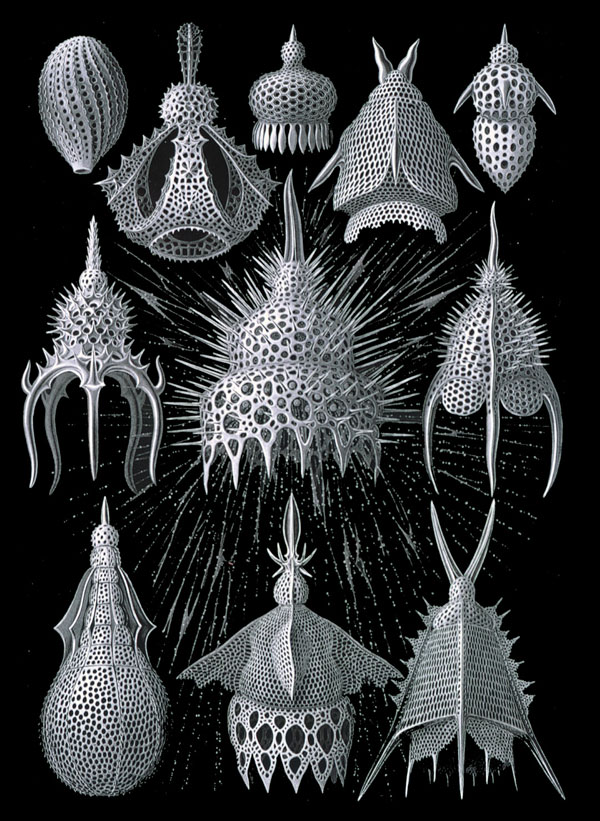
"Proteus" - film about Ernst Haeckel's work on radiolarians

Faculty of 1000's newsletter online (The Scientist) featured a documentary by David Lebrun on the life and work of Ernst Haeckel.  As it happens, I had written a post  back in July 2008 about Haeckel's book of drawings of radiolarians (Kunstformen der Natur) available online, which is why I recalled his name. There's a clip of Lebrun's documentary with the article - all animated with Haeckel's images - mind-boggling!

Wednesday, December 29, 2010

NSF mandate for Data Management Plans - help from the UMass Amherst Libraries

Beginning January 18, 2011, proposals submitted to the National Science Foundation must include a supplementary document of no more than two pages labeled “Data Management Plan”. This supplementary document should describe how the proposal will conform to NSF policy on the dissemination and sharing of research results.
To assist investigators, the National Science Foundation is providing FAQs and guidance documents from specific Directorates that address compliance. The entire policy, FAQ list, and links to Directorate information are available at http://www.nsf.gov/bfa/dias/policy/dmp.jsp. For full policy implementation, see the Grant Proposal Guide Chapter II.C.2.j.
Several federal and non-governmental funding agencies have their own set of requirements for data sharing. See for example, the University of Minnesota's list of funding agency data guidelines.

UMass Amherst Libraries: Data Working Group and Data Management Services

To help researchers meet the NSF’s requirements, the Data Working Group is coordinating the development of a number of services to help researchers analyze existing data management practices or create new practices that best fit the needs of their research projects.
Relevant services include:
  1. Guidance in the identification of appropriate data repositories for the archiving of large-scale data sets and associated research outputs, and assistance with material deposition.
  2. Consultation on metadata and standards for format and content of data, policies for data sharing and accessibility, and plans for long-term access and preservation of data sets.
  3. Provision of a globally accessible and widely indexed online location for faculty’s research outputs, including persistent URLs and searchable metadata, through ScholarWorks, the University's Institutional Repository.
This list of services will expand as the work of the Data Working Group and the Digital Strategies Group continues.
More information is available on the Library website under Services for Faculty:
http://www.library.umass.edu/services/services-for-faculty/data-management/

Article worth reading from Aug 2010: I Hate Your Paper - The Scientist - Magazine of the Life Sciences - by Jef Akst

Thought-provoking commentary on the problems of the peer-review system due to bias or other (un)professional conduct, and the state of science and science funding. Lively comments from readers after the article are also worth reading - peer-review is fine on the whole; there are not too few, but too many papers published; that the fault lies with the editors, publishers, etc. Peer-review is changing now; I am interested to see how this plays out in this brave new world we have created.

I will likely reference this article when I talk to students about peer-review in library sessions.

I Hate Your Paper - The Scientist - Magazine of the Life Sciences -
Many say the peer review system is broken. Here’s how some journals are trying to fix it.