I like the science news site, The Scientist, which, despite it's title is focused on life sciences only. This week, they have an issue devoted to sex, a hot topic, if you will excuse the pun.
Showing posts with label The Scientist. Show all posts
Showing posts with label The Scientist. Show all posts
Thursday, July 10, 2014


Friday, October 26, 2012
"Lamarck and the Missing Lnc" - from The Scientist
Nice overview by Kevin B. Morris in the cover story of The Scientist, Lamarck and the Missing Lnc, of the work in epigenetics which is challenging the basic tenet of evolution that random mutation is the only source of change in genetics.
As I understand it, serious challenges to an individual's survival may cause heritable changes in the ability of the DNA to express particular regions of the genetic code. "Long noncoding RNAs (lncRNAs) are transcripts generally expressed from regions of 'junk' DNA that are not thought to code for proteins" but now it seems they may be controlling the expression of the genes, controlling when and how much of a particular protein is produced by the cell. Suppression of the expression caused by an environmental challenge may be heritable.
(See images 1: The Epigenetic LNC, 2: A Mechanism for a Targeted Change, and 3: Directing Evolution)
Back in the dawn of genetics, Jean-Baptiste Pierre Antoine de Monet, Chevalier de la Marck, often known simply as Lamarck, theorized that traits formed in an individual's life would then be passed on to it's offspring; for example, a giraffe could develop a long neck because it stretched it reaching for forage up high, and their offspring would inherit longer necks as a result. Lamarck's theory has been a prime example of a thoroughly de-bunked scientific theory for decades.
These developments don't exactly support Lamarck's theory, but there is more than a whiff of Lamarckism about them. And, there do seem to be holes in the strict Darwinism now. Exciting times!
As I understand it, serious challenges to an individual's survival may cause heritable changes in the ability of the DNA to express particular regions of the genetic code. "Long noncoding RNAs (lncRNAs) are transcripts generally expressed from regions of 'junk' DNA that are not thought to code for proteins" but now it seems they may be controlling the expression of the genes, controlling when and how much of a particular protein is produced by the cell. Suppression of the expression caused by an environmental challenge may be heritable.
(See images 1: The Epigenetic LNC, 2: A Mechanism for a Targeted Change, and 3: Directing Evolution)
Back in the dawn of genetics, Jean-Baptiste Pierre Antoine de Monet, Chevalier de la Marck, often known simply as Lamarck, theorized that traits formed in an individual's life would then be passed on to it's offspring; for example, a giraffe could develop a long neck because it stretched it reaching for forage up high, and their offspring would inherit longer necks as a result. Lamarck's theory has been a prime example of a thoroughly de-bunked scientific theory for decades.
These developments don't exactly support Lamarck's theory, but there is more than a whiff of Lamarckism about them. And, there do seem to be holes in the strict Darwinism now. Exciting times!
Monday, August 13, 2012
"Whither Science Publishing?" in The Scientist
The Scientist has an issue focusing on science publishing, it's problems, strengths, and future. This includes discussion of open access publishing, peer review, funder mandates, etc., and it polls a wide range of opinion.

Tuesday, May 01, 2012
Inexpensive ethylene sensor reported
Megan Scudellari reported in The Scientist on April 30 in "Sensor Measures Produce Ripeness," on a 25 cent ethylene sensor developed by chemists at MIT that could help grocers and shippers gauge the ripeness of fruits and vegetables.
The sensor, described April 19 in the journal Angewandte Chemie [International Edition], is made of an array of tens of thousands of carbon nanotubes modified with copper atoms, which bind ethylene and allow scientists to measure the amount of gas present. The researchers successfully tested their sensors on bananas, avocados, apples, pears, and oranges, accurately determining their ripeness.
The inexpensive devices could someday be attached to cardboard boxes of produce and scanned with a handheld device to reveal the contents’ ripeness, said [MIT's Timothy] Swager. Then, grocers would know when to put items on sale before they get too ripe.If you are a member of the University of Massachusetts Amherst community, you can read the Angewandte Chemie article using the library's subscription.
- On campus, use this link.
- Off campus, use this link - you will need to authenticate yourself using an OIT username and password, and navigate to the full text of the article.
As a past student of post-harvest physiology, I suspect this device could be a real boon to the industry and the consumer, and result in much less wasted produce.
Tuesday, February 07, 2012
Petition to boycott Elsevier journals up to [nearly] 4500 signatures
Elsevier, a scientific publisher, has recently raised the ire of scientists and mathematicians (and librarians) concerned about the rise in journal prices, business practices, and lobbying stances taken by academic publishers.
Well-known mathematician, Tim Gowers, in a piece on his Gowers’s Weblog, was the proximate cause of the latest campaign in reaction to these issues. He took a stand on Elsevier's practices and positions, namely, the high cost of their journals, the bundling many journals in packages for academic libraries, their 'ruthless' reactions when libraries object to this practice, and their support for the Research Works Act (which would discourage the open access publishing movement) and SOPA and PIPA. That a prominent mathematician would publicly proclaim his refusal to publish in, or engage in reviewing or editing Elsevier journals caught the attention of the scientific community. It inspired Tyler Neylon to put up an online petition, The Cost of Knowledge, where scientists could register their commitment to boycott Elsevier in those specific ways.
In the time it has taken me to write these words, the number of signatories went from 4479 to 4492. I will check one more time before I finish this post.
Elsevier, naturally, doesn't agree with Mr. Gower. A piece in The Scientist outlines their position - it didn't make a lot of sense to me, so I will leave it to my readers to judge for themselves. I hasten to add that Elsevier is merely one of the scholarly publishers with these issues, albeit one with the highest priced journals. It's a complex market/situation/issue. I wouldn't recommend the Wikipedia article on this topic (Serials Crisis) as it currently stands. If you would like to know more about it, please contact me.
Librarians have been shouting about these issues for a long time - we are on the front line in the struggle to provide access to the academic literature. One could say that we have done such a good job that the problem was obscured to most people - they could get the stuff they needed, so why would they complain? One of the points that Elsevier does not address in The Scientist piece is that the rate of inflation for academic journals overall has been about 8% per year - much higher than nearly everything else in the economy, including the rise in tuition and fees to students, or academic salaries. (I've been looking for reasonable sources for this contention but I can't lay my hands on it right now - will provide later.) It has occurred to me that perhaps commercial publishers are milking the situation as hard as they can now because they see the writing on the wall, so to speak - their cash cow is nearly spent.
Tim Gowers's blog is thoughtful - he had no intention of starting a movement, and he is moving on to looking for alternatives to Elsvier. I particularly liked reading his post "What's wrong with electronic journals."
The petition just went over 4500.
Well-known mathematician, Tim Gowers, in a piece on his Gowers’s Weblog, was the proximate cause of the latest campaign in reaction to these issues. He took a stand on Elsevier's practices and positions, namely, the high cost of their journals, the bundling many journals in packages for academic libraries, their 'ruthless' reactions when libraries object to this practice, and their support for the Research Works Act (which would discourage the open access publishing movement) and SOPA and PIPA. That a prominent mathematician would publicly proclaim his refusal to publish in, or engage in reviewing or editing Elsevier journals caught the attention of the scientific community. It inspired Tyler Neylon to put up an online petition, The Cost of Knowledge, where scientists could register their commitment to boycott Elsevier in those specific ways.
In the time it has taken me to write these words, the number of signatories went from 4479 to 4492. I will check one more time before I finish this post.
Elsevier, naturally, doesn't agree with Mr. Gower. A piece in The Scientist outlines their position - it didn't make a lot of sense to me, so I will leave it to my readers to judge for themselves. I hasten to add that Elsevier is merely one of the scholarly publishers with these issues, albeit one with the highest priced journals. It's a complex market/situation/issue. I wouldn't recommend the Wikipedia article on this topic (Serials Crisis) as it currently stands. If you would like to know more about it, please contact me.
Librarians have been shouting about these issues for a long time - we are on the front line in the struggle to provide access to the academic literature. One could say that we have done such a good job that the problem was obscured to most people - they could get the stuff they needed, so why would they complain? One of the points that Elsevier does not address in The Scientist piece is that the rate of inflation for academic journals overall has been about 8% per year - much higher than nearly everything else in the economy, including the rise in tuition and fees to students, or academic salaries. (I've been looking for reasonable sources for this contention but I can't lay my hands on it right now - will provide later.) It has occurred to me that perhaps commercial publishers are milking the situation as hard as they can now because they see the writing on the wall, so to speak - their cash cow is nearly spent.
Tim Gowers's blog is thoughtful - he had no intention of starting a movement, and he is moving on to looking for alternatives to Elsvier. I particularly liked reading his post "What's wrong with electronic journals."
The petition just went over 4500.
Note: 9 Feb they are approaching 5000 signers.
6 April, approaching 9000
6 April, approaching 9000
Friday, August 05, 2011
Integrity Guidelines Up for Public Review - post in The Scientist
From the online newsletter, The Scientist:
The National Science Foundation (NSF) released a draft summarizing its principles for scientific integrity and outlining new principles which it plans to implement at the end of the year, and has invited the public to chime in.
The draft is available in the Federal Register online:
It asserts the intention of the NSF to support open and transparent processes in awarding of grants, media policy, and making the results of research available to the public.
From the draft:
SUMMARY: On March 9, 2009, President Obama issued a Memorandum for the Heads of
Executive Departments and Agencies on Scientific Integrity. Shortly thereafter the Office of
Science and Technology Policy (OSTP) led an interagency task group to develop an
implementation strategy, and NSF was represented on the task group. On December
17, 2010, the OSTP Director issued a Memorandum with implementation guidance (for copies
of both memoranda, see:
http://www.whitehouse.gov/administration/eop/ostp/library/scientificintegrity).
      NSF is fully committed to its efforts to ensure that our processes will advance the goals
articulated in the Memoranda. This report summarizes NSF practices both current and planned
to maintain and enhance scientific integrity across our S&E community. The report is
organized according to the major headings and topics of the December 2010 OSTP Memorandum.

DATES: Comments on the report are welcome before September 6, 2011.
Comments will be useful in shaping the agency's implementation. Please send comments to
siip_comments@nsf.gov. All comments received before the close of the comment period will be
available for public inspection, including any personally identifiable or confidential business
information that is included. Because they will be made public, comments should not include
any sensitive information.

FOR FURTHER INFORMATION CONTACT:
  siip_comments@nsf.gov.
Major headings of the draft report:
I. Foundations of Scientific Integrity In Government
II. Public Communications
III. Use of Federal Advisory Committees (FAC)
IV. Professional Development of Government Scientists and Engineers
V. Implementation
II. Public Communications
III. Use of Federal Advisory Committees (FAC)
IV. Professional Development of Government Scientists and Engineers
V. Implementation
Tuesday, May 24, 2011
Lessons in discovery and democracy from fellow organisms
If I am reading her right, in "Channeling the Microbiome" a recent article in The Scientist, Sarah Greene suggests that horizontal gene transfer can be seen as an analogy to information sharing among scientists, and other human beings, and that we might learn from our micro-cousins.
An interview with developmental biologist Peter A. Lawrence of Cambridge University, entitled “The Heart of Research is Sick,” was recently published in the UK magazine Lab Times. Lawrence points out that at its core, science must be about the discovery process, which may not be selected for in a highly competitive environment that rewards the most aggressive individuals and tends to diminish the efforts of younger scientists and women.In NPR (Morning Edition, May 24, 2011) piece on how bees select a site for a new hive ("Nature's Secret: Why Honey Bees are Better Politicians than Humans") Robert Krulwich reveals a method of persuasion that causes individual bees to investigate the suitability of proposed sites that eventually leads to them picking the best site, essentially by consensus.
Each scout's dance tells the other bees how to fly to the site — this is done by "waggle dancing," a figure dance that gives bees directions. And if a bee really likes the site, she will dance her directions over and over and over, literally hundreds of times. That way, more and more of her sister scouts see the dance, know where to go, and can fly off and check for themselves.Sounds like fun, and an excellent model. One wonders why the purportedly most intelligent species finds it so difficult to make good decisions.
If the site is ho-hum, the second wave of bees will do a ho-hum, say, 10-repetition dance. But if the site is spectacular — high off the ground, narrow opening, facing the right direction, lots of honey storage space inside — then they will give it a spectacular, say, 300-round dance, so more scouts will know where to go. If they like the site, pretty soon everybody is doing the same dance: Let's call it "The Elm Tree" dance.
This is how bees "vote;" they dance themselves into a consensus.
Thursday, April 14, 2011
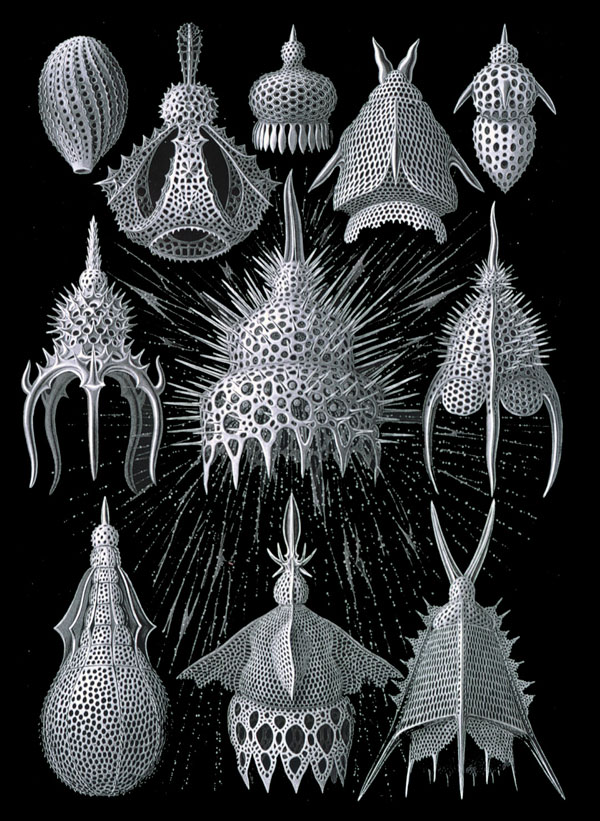
"Proteus" - film about Ernst Haeckel's work on radiolarians
Wednesday, December 29, 2010
Article worth reading from Aug 2010: I Hate Your Paper - The Scientist - Magazine of the Life Sciences - by Jef Akst
Thought-provoking commentary on the problems of the peer-review system due to bias or other (un)professional conduct, and the state of science and science funding. Lively comments from readers after the article are also worth reading - peer-review is fine on the whole; there are not too few, but too many papers published; that the fault lies with the editors, publishers, etc. Peer-review is changing now; I am interested to see how this plays out in this brave new world we have created.
I will likely reference this article when I talk to students about peer-review in library sessions.
I Hate Your Paper - The Scientist - Magazine of the Life Sciences -
I will likely reference this article when I talk to students about peer-review in library sessions.
I Hate Your Paper - The Scientist - Magazine of the Life Sciences -
Subscribe to:
Posts (Atom)