Showing posts with label Nature. Show all posts

Wednesday, November 12, 2014

Interview with Google Scholar co-creator, Anurag Acharya

In my instruction sessions with students, I often do a quick poll of how many people use Google Scholar to find articles - the percentage has gone up substantially in recent years, and it makes me wonder about the money we spend on buying access to bibliographic index databases. But that's a discussion for another day.

These days, every faculty member and grad student I have asked in individual consultation sessions uses Google Scholar.

I'd say most librarians have conflicted feelings about Google Scholar, and this interview doesn't do anything to change that. We still don't know where Google Scholar is looking - or where it is not looking. But it's interesting to hear from a person who is instrumental in developing something which in ten years has transformed how scholarly research is discovered.
See also a linked article:

Tuesday, July 01, 2014

Two hypotheses for our two-faced moon


Our moon has two very different faces: the near side and the far side are quite different from one another. Today, Slate's Phil Plate covers two hypotheses on just why the two sides of our moon are so different. Definitely check out Plate's quick synopsis of the two hypotheses, and if you are hungry for more, dive in to the two resources he covers!
Hypothesis one comes from Nature:
Jutzi, M., & Asphaug, E. (2011). Forming the lunar farside highlands by accretion of a companion moon. Nature, 476(7358), 69-72. http://www.nature.com/nature/journal/v476/n7358/abs/nature10289.html
Hypothesis two you'll find via arxiv.org:
Roy, A., Wright, J. T., & Sigurðsson, S. (2014). Earthshine on a Young Moon: Explaining the Lunar Farside Highlands. The Astrophysical Journal Letters, 788(2), L42. http://arxiv.org/pdf/1406.2020.pdf
If you have any trouble accessing either of these two resources, feel free to ask a librarian! We are happy to help you figure out how to get access to all sorts of resources.
Happy searching! 

Thursday, November 08, 2012

Prenatal learning in wrens - mind-boggling!

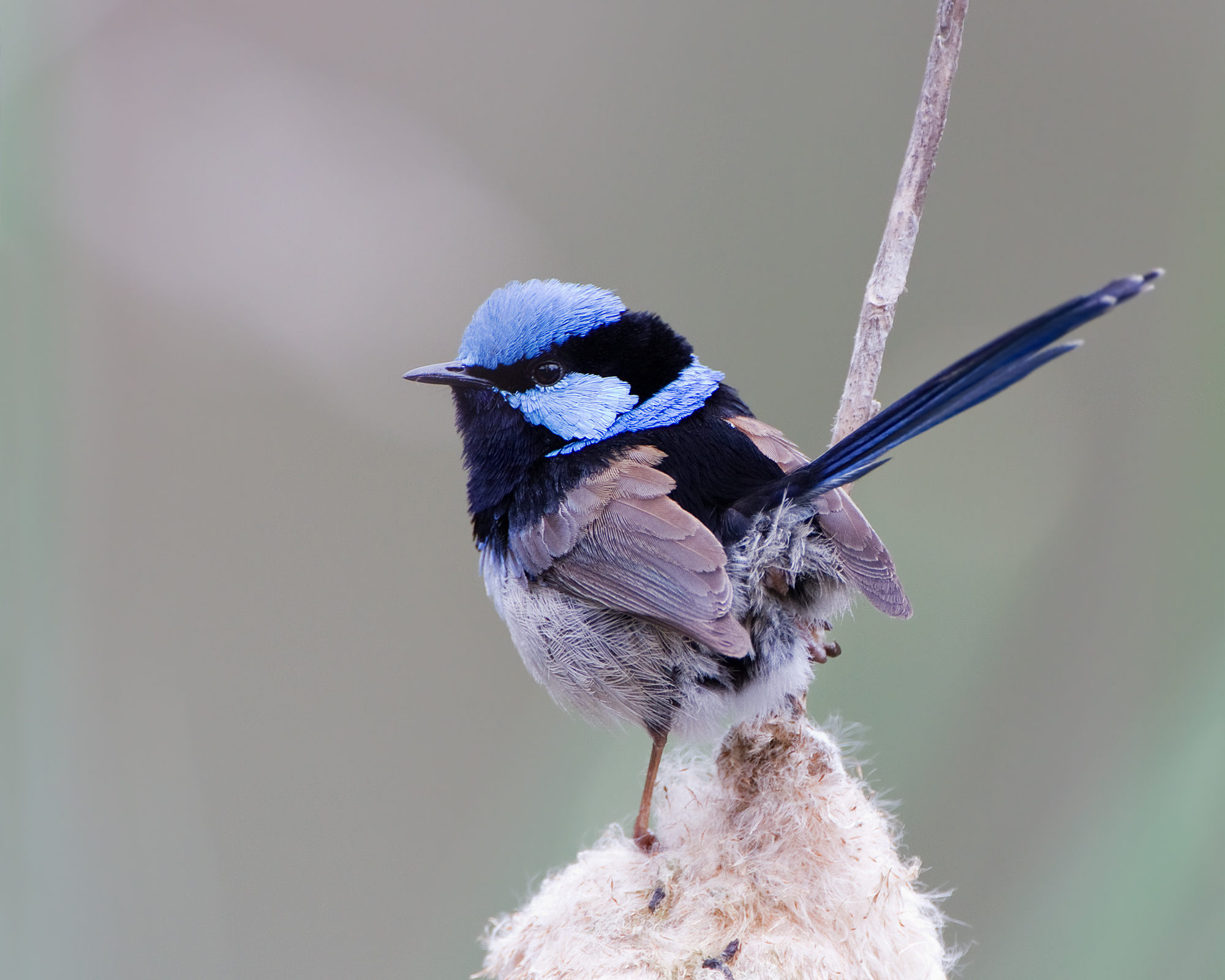
The title of this news article in Nature, 8 November, "Wrens teach their eggs to sing" is a little misleading - Superb Fairywren (Malurus cyaneus) mothers are teaching their offspring to make a specific begging call that allows them to distinguish between their chicks and cuckoo hatchlings.  They start calling to the eggs about 10 days before they hatch, and the hatchlings must make this call in order to be fed.  Apparently, cuckoo eggs hatch earlier than those of the wrens, but they aren't capable of learning the call in time.  The cuckoo nestling will push unhatched wren eggs out of the nest. This 'secret password' mechanism allows the parents to waste less time feeding a chick that isn't their own; they will abandon the lone cuckoo chick to start on another brood.

Superb Fairywren photo from Wikimedia Commons by JJ Harrison
Superb Fairywren (Malurus cyaneus) photo by JJ Harrison http://en.wikipedia.org/wiki/File:Malurus_cyaneus_PM.jpg
The finding was discovered by accident by researchers at Flinders University in Adelaide by Sonia Kleindorfer's team.
They were recording inside the birds' domed nests in search of anti-predator calls when they noticed that female fairy-wrens were singing to their unhatched eggs.  When Kleindorfer and her team analysed recordings made over the full nesting cycle, they found that the wren nestlings in a given nest all had the same begging call, which was unique to their nest. [My emphasis] That call contained a signature element present in the call the mothers had made while incubating the eggs, and in the call she used to solicit food from the father. When the researchers broadcast a foreign nestling call at the nests, both the female and male adult birds refused to feed the chicks.
Cross-fostering the wren eggs, i.e.,  switching the eggs in the nest with the eggs of another wren pair before the parents started making the calls, showed that the specific call was learned, not genetic. The system isn't perfect, though. One cuckoo species,  is always identified by the wrens, but another succeeds in finding the right password call some of the time. "Kleindorfer says there is evidence that, in the latter species, the cuckoo nestlings attempt to guess the password by trying out different calls."

I have always found it amazing that parents of parasitized species don't recognize the cuckoo chicks as intruders without a mechanism like this.  Other species, such as cowbirds have the habit of parasitizing other species's nests.

The original research was published as a report in Current Biology, [in press, corrected proof, at this time] "Embryonic Learning of Vocal Passwords in Superb Fairy-Wrens Reveals Intruder Cuckoo Nestlings" http://dx.doi.org/10.1016/j.cub.2012.09.025


Friday, October 01, 2010

News article from Nature: "Emperor penguin's old clothes are unveiled"

Fossilized feathers reveal colourful past.

A 36-million-year-old fossilized penguin skeleton found on a cliff-face in Peru has given scientists insight into how penguin feathers, originally used for flight, adapted to swimming. The fossil, found by palaeontology student Ali Altamirano of the Museum of Natural History in Lima, contained intact pigments which researchers say mean that, instead of the black and white plumage of modern-day penguins, the ancient bird sported grey and reddish-brown feathers.
Image caption: The fossilised remains of a giant penguin reveals the birds were not always black and white. - Katie Browne, U.T. Austin
... [article continues - click on title to go to the original article]