- "Discern the highest value nanoelectronics standards to provide maximum leverage to the industry by providing a platform of common definitions, processes and technologies.
- Identify a small set of near-term standards to jump start nanoelectronics standards development. Frame these standards (define their scope and purpose) to accelerate working group formation and progress. Build momentum within the industry by creating a few quick wins consistent with the longer range standards strategy.
- Complement, not replace, existing industry roadmaps and knowledge bases.
- Provide a framework for efficient communication and collaboration among industry members. Reduce barriers to industry convergence and efficient commerce.
- Speed the development and deployment of high value nanoelectronics standards; consistent with the maturity of processes and technologies.
- Create an extensible and living framework by which nanoelectronics standards development may be managed proactively, strategically and efficiently"
Friday, April 27, 2007
IEEE Standards Association creates Nanoelectronics Standards Roadmap
On April 14th, the IEEE Standards Association released a Nanoelectronics Standards Roadmap, version 1.0. This draft is available for public comment from their website. The roadmap is intended to:


Thursday, April 12, 2007
NN/LM-NER's PubMed Search Tags and Field Qualifiers Guide
Check out the latest revision of the NN/LM-NER's PubMed Search Tags and Field Qualifiers Guide!
http://nnlm.gov/ner/training/material/PubMedFieldTags.doc
Search like an expert! This handy guide lists the major search tags and field qualifiers for advanced PubMed searching. Keep it next to your computer for easy reference.
This guide is intended to be customized with your library's logo and contact information, folded in half and laminated. Don't have a laminator? No problem. It also makes a nice one page handout.
Or better yet... customize and post it on your web site!
Check out Boston University Medical Center's customized version at: http://med-libwww.bu.edu/pdf/pubmedfieldtags.pdf
Thanks to Michelle Eberle - Consumer Health Information Coordinator - National Network of Libraries of Medicine - New England - University of Massachusetts Medical School - for this information.
http://nnlm.gov/ner/training/material/PubMedFieldTags.doc
Search like an expert! This handy guide lists the major search tags and field qualifiers for advanced PubMed searching. Keep it next to your computer for easy reference.
This guide is intended to be customized with your library's logo and contact information, folded in half and laminated. Don't have a laminator? No problem. It also makes a nice one page handout.
Or better yet... customize and post it on your web site!
Check out Boston University Medical Center's customized version at: http://med-libwww.bu.edu/pdf/pubmedfieldtags.pdf
Thanks to Michelle Eberle - Consumer Health Information Coordinator - National Network of Libraries of Medicine - New England - University of Massachusetts Medical School - for this information.
Tuesday, April 10, 2007
Illustrata: Natural Sciences database trial until May 5 2007
Illustrata: Natural Sciences is a new database that provides access to charts, tables, graphs, photographs, maps and other figures across a wide range of biological and environmental disciplines. With Illustrata: Natural Sciences it is possible to search the scholarly research literature for visual information previously not indexed. Using the “Search Tools” feature it is possible to search the scientific literature for graphs, illustrations, maps, photographs, tables and images.
“Researchers can then view the full object, including all caption and label text. Results can be easily saved or imported and used for presentations, lectures, or research.”
More than one million object records have been indexed covering over 880 different journals from a variety of publishers. It is projected that over two million objects will be indexed by the end of the year.
Three other forthcoming Illustrata resources include image databases for the fields of Technology, Social Sciences and Arts & Humanities.
Please let Maxine Schmidt (mschmidt@library.umass.edu) know your impression of Illustrata: Natural Sciences.
“Researchers can then view the full object, including all caption and label text. Results can be easily saved or imported and used for presentations, lectures, or research.”
More than one million object records have been indexed covering over 880 different journals from a variety of publishers. It is projected that over two million objects will be indexed by the end of the year.
Three other forthcoming Illustrata resources include image databases for the fields of Technology, Social Sciences and Arts & Humanities.
Please let Maxine Schmidt (mschmidt@library.umass.edu) know your impression of Illustrata: Natural Sciences.
Monday, March 12, 2007
Geoscience World database trial until April 5 2007
Here's what the site has to say about itself:
Be aware, though, that because this is a trial, you won't find the handy little red SFX links that will take you to the full text sources for other journals. To get those, go through the Library's webpage to GeoRef, where you will be properly authenticated.
Let Maxine Schmidt (mschmidt@library.umass.edu) know what you think of GSW.
It also says that it is "indexed, linked, and inter-operable" with GeoRef. Right now, GSW is offering the content of the journals published by the founding member organizations: American Association of Petroleum Geologists (AAPG), American Geological Institute (AGI), Geological Society of America (GSA), The Geological Society of London (GSL), Mineralogical Society of America (MSA), Society for Sedimentary Geology (SEPM), and Society of Exploration Geophysicists (SEG)."GeoScienceWorld (GSW) is a nonprofit corporation formed by a group of leading geoscientific organizations for the purpose of making geoscience research and related information easily and economically available via the Internet. GSW is an unprecedented collaboration of six leading earth science societies and one institute."
Be aware, though, that because this is a trial, you won't find the handy little red SFX links that will take you to the full text sources for other journals. To get those, go through the Library's webpage to GeoRef, where you will be properly authenticated.
Let Maxine Schmidt (mschmidt@library.umass.edu) know what you think of GSW.
Tuesday, March 06, 2007
Cold Spring Harbor Protocols database - Subscription!
The UMass Amherst Libraries have subscribed to the Cold Spring Harbor Protocols database. In response to the requests of several patrons, we conducted a trial subscription last fall, and the reaction from most respondents was very positive. As a consequence, and because these methods are widely used on campus, we have added this database to our extensive collection.
From the "About" section of the CSH Protocols Website:
Cold Spring Harbor Protocols is a definitive, interactive source of new and classic research techniques. The database is fully searchable by keyword and subject, and it has many novel features—such as discussion forums and personal folders—made possible by online publication. Its coverage includes cell and molecular biology, genetics, bioinformatics, protein science, and imaging. Protocols are presented step-by-step and edited in the style that has made Molecular Cloning, Antibodies, Cells and many other CSH manuals essential to the work of scientists worldwide. Protocols will be continuously expanded, updated, and annotated by the originators and users of the techniques.
If you have any questions or comments, please contact the ISEL Library staff.
From the "About" section of the CSH Protocols Website:
Cold Spring Harbor Protocols is a definitive, interactive source of new and classic research techniques. The database is fully searchable by keyword and subject, and it has many novel features—such as discussion forums and personal folders—made possible by online publication. Its coverage includes cell and molecular biology, genetics, bioinformatics, protein science, and imaging. Protocols are presented step-by-step and edited in the style that has made Molecular Cloning, Antibodies, Cells and many other CSH manuals essential to the work of scientists worldwide. Protocols will be continuously expanded, updated, and annotated by the originators and users of the techniques.
If you have any questions or comments, please contact the ISEL Library staff.
Friday, March 02, 2007
UMass Amherst Digital Quadrangle Series Colloquium: " Showcasing Research and Teaching in the 21st Century: A Digital Approach"
NEWS RELEASE: FOR IMMEDIATE RELEASE DATE: 03/1/07
CONTACT: LESLIE SCHALER, COMMUNICATION ASST., (413) 545-0162
The second half of the program includes two panel discussions. In the first, “The ScholarWorks Track: A Panel of Case Studies,” faculty members will discuss the adoption of ScholarWorks and its impact on their research and teaching. Representatives from the Center for Teaching, Office for Research, Graduate School, and UMass Press will serve on the second panel, “Tools and Policies: Getting to Your Destination.” Discussion topics will include intellectual property, the potential for transforming teaching models, the electronic master’s theses project, and open access from the perspective of UMass Press.
For more information, contact Marilyn Billings, 545-6891, or mbillings@library.umass.edu.
Friday, February 23, 2007
The Secret to Google page ranking
From Maxine - A rather amusing explanation of how Google determines which pages are listed first when you do a search. Suffice to say it involves PCs - pigeon clusters.
Librarians and other information mavens have long wondered about Google's relevancy algorithms, which Google regards as a trade secret. We like to know how to make our search strategies as efficient as possible, and knowing how the search engine works would obviously be useful, but as a commercial enterprise, Google doesn't want to help people 'game' the system. So this explanation is meant to be funny, but at the same time, it is twitting their critics.
Librarians and other information mavens have long wondered about Google's relevancy algorithms, which Google regards as a trade secret. We like to know how to make our search strategies as efficient as possible, and knowing how the search engine works would obviously be useful, but as a commercial enterprise, Google doesn't want to help people 'game' the system. So this explanation is meant to be funny, but at the same time, it is twitting their critics.
UMASS AMHERST LIBRARIES TO SURVEY CAMPUS COMMUNITY
Amherst, MA – The UMass Amherst Libraries will conduct a survey, LibQUAL+™, of all faculty members and graduate students, and a random sample of 2,000 undergraduates between February 27 and March 16, 2007. Participants will be emailed and asked to participate in the 10-minute web-based survey. A free beverage coupon to the Procrastination Station Café in the Du Bois Library will be given to those completing the survey.
The results of the survey will be used to help assess and improve the UMass Amherst Libraries’ services, collections, and facilities. The results will also indicate how UMass Amherst library services compare to other institutions of similar size and mission. It will allow the Libraries to benchmark its results against those of other colleges and universities to determine best practices and indicate where to concentrate improvements for UMass Amherst users. UMass Amherst is among over 200 libraries participating in this year's survey.
In 2004, the UMass Amherst Libraries conducted a LibQUAL+™ survey, contributing to the Libraries’ initiating many improvements, particularly in the Du Bois Library. Improvements include more electronic resources, increased hours to 24 hours/five days a week, increased wireless access, group study rooms, comfortable chairs, additional computers, scanners, a fax machine, and vending machines on the Lower Level, quiet study spaces on Floors 2 and 3, a renovated lobby with a coffee shop, book delivery on campus, and more flexible lending policies.
LibQUAL+ ™ is a rigorously tested web-based survey administered by the Association of Research Libraries (ARL).
For more information, contact Jan Higgins in the Library Office, at 545-6868 or libqual@library.umass.edu. More information about the survey is available at www.library.umass.edu/assessment/libqual.html.
The results of the survey will be used to help assess and improve the UMass Amherst Libraries’ services, collections, and facilities. The results will also indicate how UMass Amherst library services compare to other institutions of similar size and mission. It will allow the Libraries to benchmark its results against those of other colleges and universities to determine best practices and indicate where to concentrate improvements for UMass Amherst users. UMass Amherst is among over 200 libraries participating in this year's survey.
In 2004, the UMass Amherst Libraries conducted a LibQUAL+™ survey, contributing to the Libraries’ initiating many improvements, particularly in the Du Bois Library. Improvements include more electronic resources, increased hours to 24 hours/five days a week, increased wireless access, group study rooms, comfortable chairs, additional computers, scanners, a fax machine, and vending machines on the Lower Level, quiet study spaces on Floors 2 and 3, a renovated lobby with a coffee shop, book delivery on campus, and more flexible lending policies.
LibQUAL+ ™ is a rigorously tested web-based survey administered by the Association of Research Libraries (ARL).
For more information, contact Jan Higgins in the Library Office, at 545-6868 or libqual@library.umass.edu. More information about the survey is available at www.library.umass.edu/assessment/libqual.html.
Tuesday, February 20, 2007
Check it out! Origami and Math from Robert J. Lang

A recent profile in The New Yorker magazine of Robert J. Lang sent us to this website. Lang retired from a successful career as a physicist and engineer, during which he authored or co-authored over 80 technical publications and 40 patents on semiconductor lasers, optics, and integrated optoelectronics; he is now a full-time origami artist. His work is exhibited, and has also been used in television commercials and other media.
Lang writes and speaks extensively on the intersection of origami and mathematics, and has developed computer applications to simulate and help design origami. Dr. Lang resides in Alamo, California.
And yes, this "dancing crane" was folded from a single sheet without cuts. Lang's website has images of his work, many with crease patterns which (theoretically) one could use to reproduce the figure.
Thursday, November 09, 2006
Database Trial: CSH Protocols
We have a trial set up for the subscription database, CSH Protocols, or Cold Spring Harbor Protocols (http://www.cshprotocols.org). This includes the full text of the latest versions of their laboratory methods in molecular and cellular biology. If this is of interest to you, please give it a try, and let me, Naka Ishii, know if you think this is a worthwhile addition to our collection.
As with any new library resource, if we decide it is valuable, we will need to figure out how to fund it, and weigh the options against the utility of the new resource, so please be clear about how useful it is, what priority you would give it.
You can also access this trial through our Database Trials webpage on the Library's website. From the Library homepage, www.library.umass.edu, click on the tab for Services, then from that list, select Research Help and Support. On the left side of that page, there is a link to the Database Trials page.
Thanks in advance for your help in evaluating CSH Protocols.
As with any new library resource, if we decide it is valuable, we will need to figure out how to fund it, and weigh the options against the utility of the new resource, so please be clear about how useful it is, what priority you would give it.
You can also access this trial through our Database Trials webpage on the Library's website. From the Library homepage, www.library.umass.edu, click on the tab for Services, then from that list, select Research Help and Support. On the left side of that page, there is a link to the Database Trials page.
Thanks in advance for your help in evaluating CSH Protocols.
Friday, October 20, 2006
Darwin Goes Digital
Cambridge University is in the process of making the complete works of Charles Darwin available online. The collection includes images of books and manuscripts, as well as Darwin's field notebooks! So far the developers estimate that 50% of the total material is now accessible, and more is added each day. They expect to complete the project in 2009.
Thursday, August 31, 2006
A new look to UMass Amherst Library Website, and the new online catalog
The Library's Website has undergone a radical redesign, and we hope that our patrons will find it easier to use, once they get over the initial shock. The content is essentially the same, except for the new catalog, which had its debut this week also.
In the months to come, we are also changing the way the contents of the Library's Website are organized, so that behind the scenes, it will be contained in a "content management system." While we hope that this change will be invisible to our patrons, we also believe that it will allow the content to be more current, since global changes will be easier to make.
The new online library catalog, mentioned above, has 'gone live' as they are saying over in Du Bois, and it is not without problems. This gigantic piece of software is really called an 'integrated library system' or ILS. An ILS not only contains the catalog of our materials and electronic resources, it also includes the circulation system and all the transactions, patrons, holds, bills, etc., and the acquisitions module - this tracks all the library materials we order and purchase. On top of that, this one system is shared by five separate institutions, the Five Colleges; so you can see that glitches are inevitable in the implementation of something so massive. We beg your patience and understanding.
That said, please do let us know when you encounter a problem. You might be the first one to notice something awry. Do also let us know if you find something that you like - though at this juncture I'm not holding my breath!
Wish us luck!
In the months to come, we are also changing the way the contents of the Library's Website are organized, so that behind the scenes, it will be contained in a "content management system." While we hope that this change will be invisible to our patrons, we also believe that it will allow the content to be more current, since global changes will be easier to make.
The new online library catalog, mentioned above, has 'gone live' as they are saying over in Du Bois, and it is not without problems. This gigantic piece of software is really called an 'integrated library system' or ILS. An ILS not only contains the catalog of our materials and electronic resources, it also includes the circulation system and all the transactions, patrons, holds, bills, etc., and the acquisitions module - this tracks all the library materials we order and purchase. On top of that, this one system is shared by five separate institutions, the Five Colleges; so you can see that glitches are inevitable in the implementation of something so massive. We beg your patience and understanding.
That said, please do let us know when you encounter a problem. You might be the first one to notice something awry. Do also let us know if you find something that you like - though at this juncture I'm not holding my breath!
Wish us luck!
Tuesday, August 15, 2006
A new library catalog!
The Five College Library System is instituting a big change. A new Five College Library Catalog will debut the week of August 28, 2006, providing improved access to the millions of resources at the UMass Amherst Libraries and those of the Amherst , Hampshire, Mount Holyoke
The software will make searching for information easier. For example, it will permit online searching of all libraries simultaneously, foreign language searches, focusing searches on specific research areas, and limiting searches to a particular collection or format (i.e. book, CD, journal, etc.). It will now be possible for users to set up personal accounts to receive email notifications of new arrivals in designated subject areas, and to review personal searches and borrowing histories.
As part of the transition, the five-college request function and self- renewal features will be temporarily suspended from August 19 until the week of August 28, 2006 and the virtual catalog request function has been suspended through January 2007. Interlibrary Loan and Document Delivery will continue to operate normally and users can continue to submit requests.
ALEPH was created by a team of librarians, systems analysts, and programmers to provide an automated library system that was efficient, user-friendly, and multilingual. Other libraries using the ALEPH software include Harvard,
Staff here at the Integrated Sciences and Engineering Library and at Du Bois will be available if you need help navigating the new features, or to speak to your classes about the new system and the libraries in general. As always, feel free to call me with any questions.
Saturday, July 15, 2006
Wellcome Trust Biomedical Image Awards 2006
The Wellcome Trust has just announced its Biomedical Image Award winners for 2006. Stunning images of life from the molecular/cellular level on up. Check out the gallery...when you click on an image, you'll be given the opportunity to listen to a sound file of the scientist behind the image discussing his/her work.
Thursday, June 22, 2006
Keep up on scholarly communication issues on Create Change website
You all know that dissemination of research has been changing rapidly in recent years. Publishers, funding agencies, professional societies, educational instititutions, and others are stakeholders in how best to shape the future of this process. Libraries and librarians have long been intermediaries in this process, and are active participants in the discussion. Create Change is a website advocating for using the benefits of technology for wider access to the fruits of your labor. It also gives examples of initiatives in open access scholarly publishing from many fields of study.
From the About page of the Create Change site:
"Create Change is an educational initiative that examines new opportunities in scholarly communication, advocates changes that recognize the potential of the networked digital environment, and encourages active participation by scholars and researchers to guide the course of change.
"Create Change was developed by the Association of Research Libraries (ARL) and SPARC (Scholarly Publishing and Academic Resources Coalition) and is supported by the Association of College and Research Libraries (ACRL)."
From the About page of the Create Change site:
"Create Change is an educational initiative that examines new opportunities in scholarly communication, advocates changes that recognize the potential of the networked digital environment, and encourages active participation by scholars and researchers to guide the course of change.
"Create Change was developed by the Association of Research Libraries (ARL) and SPARC (Scholarly Publishing and Academic Resources Coalition) and is supported by the Association of College and Research Libraries (ACRL)."
Tuesday, June 20, 2006
Lost in a sea of science data
A free article from the Chronicle of Higher Education describes how librarians are teaming up with scientists to archive and preserve huge amounts of scientific data:
Science is experiencing revolutionary changes thanks to digital technology, with computers generating a flood of valuable data for scientists to interpret.(read entire article)
But that flood could drown science.
Data from experiments conducted as recently as six months ago might be suddenly deemed important, but researchers might never find those numbers — or if they did, might not know what the numbers meant. Lost in some research assistant's computer, the data are often irretrievable or an indecipherable string of digits. That's a scenario increasingly familiar to scholars, says James M. Caruthers, a professor of chemical engineering at Purdue University.
"We are starting to die from data," he says bluntly.
To vet experiments, correct errors, or find new breakthroughs, scientists desperately need better ways to store and retrieve research data, Mr. Caruthers says, or "we are going to be more and more inefficient in the science that we do in the future."
Dealing with the "data deluge," as some researchers have called it, will be among the great challenges for science in the 21st century. Many in the field say that scientists should not be left to manage the data on their own.
Instead, librarians will have to step forward to define, categorize, and archive the voluminous and detailed streams of data generated in experiments. Already, librarians on some campuses — among them Purdue, the Johns Hopkins University, and the University of California at San Diego — are beginning to take on that role.
Art of Science Competition / 2006 Gallery
Check out some really striking and lovely images and video from Princeton University's 2006 Art of Science competition....I especially liked this one:

Color Patterns of an Iron Extraction Time Series, Andrew Altevogt, Department of Civil and Environmental Engineering
More about the Art of Science competition.
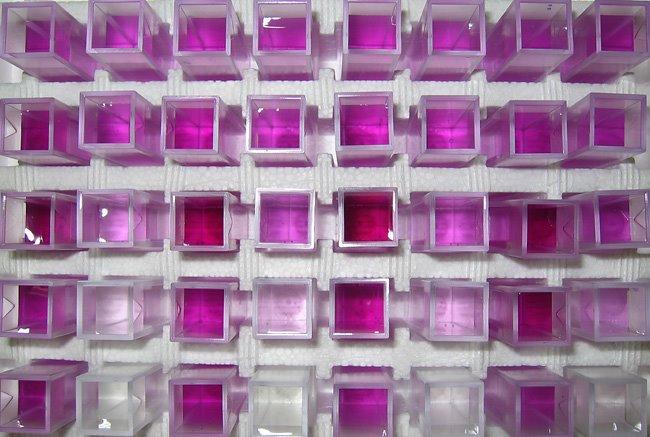
Color Patterns of an Iron Extraction Time Series, Andrew Altevogt, Department of Civil and Environmental Engineering
More about the Art of Science competition.
Thursday, June 08, 2006
Technology in Geologic Time...
I have a copy of my Geology MS thesis on a 5" floppy disk, which I carefully copied and coddled while I wrote (and rewrote and wrote and rewrote) my masterpiece. Now I might as well use it as a coaster for my double half-caf skinny latte. The era of the 31/2 disk is also well and truly over, I'm told. Are CDs and flash drives far behind? So if every new technology is doomed from its inception, how do we preserve our data for future scholars, or even for our own future projects? This concern is raised in stlq, one of my favorite blogs. Fortunately, UMass is working on a solution-- a digital repository, tentatively named UMass Scholarly Commons. For examples of other universities' digital repositories, look here. Aside from the important issue of preservation, there are other opportunities associated with this project--open access journals, for example. If you have questions, or want to become an early adopter of this technology at UMass, contact Marilyn Billings in the Library.
Monday, June 05, 2006
The impact of impact; and, peer review reexamined
Following up on Maxine's post about impact in physics....
A couple of interesting items regarding scholarly publishing have been making their way across the wires today.
(1) ACRLog points to some recent discussions about journal impact factors, including a Wall Street Journal article that discusses impact factor inflation and a Chronicle of Higher Education article (subscription required; UMass users can follow link) on problems quantifying impact in the humanities.
(2) Nature is hosting a web focus, including an online debate, regarding peer review in the scientific publication process:
These are issues that are definitely on people's minds here at UMass Amherst, as the campus undergoes a research benchmarking process and begins to explore the creation of an institutional repository.
A couple of interesting items regarding scholarly publishing have been making their way across the wires today.
(1) ACRLog points to some recent discussions about journal impact factors, including a Wall Street Journal article that discusses impact factor inflation and a Chronicle of Higher Education article (subscription required; UMass users can follow link) on problems quantifying impact in the humanities.
(2) Nature is hosting a web focus, including an online debate, regarding peer review in the scientific publication process:
Peer review is commonly accepted as an essential part of scientific publication. But the ways peer review is put into practice vary across journals and disciplines. What is the best method of peer review? Is it truly a value-adding process? What are the ethical concerns? And how can new technology be used to improve traditional models?(via Science Library Pad)
These are issues that are definitely on people's minds here at UMass Amherst, as the campus undergoes a research benchmarking process and begins to explore the creation of an institutional repository.
Monday, May 22, 2006
Physics is Hot!
Read the story here.
I found this on another blog, From Your Science Librarian's Desk , and thought it might interest people. What do you think of this characterization of research, and what do you think is behind it? I wonder about the effect of this kind of measurement of on the future of scientific learning.
I found this on another blog, From Your Science Librarian's Desk , and thought it might interest people. What do you think of this characterization of research, and what do you think is behind it? I wonder about the effect of this kind of measurement of on the future of scientific learning.
Subscribe to:
Posts (Atom)