A press release from the UMass Amherst Libraries:
DIGITAL QUADRANGLE SERIES COLLOQUIUM
“Engaging the Web for Scholarship, Pedagogy, and Publication”
Amherst, MA – UMass Amherst will host “Engaging the Web for Scholarship, Pedagogy, and Publication” on March 28, 2008, from 9:30 a.m. – 1:30 p.m. in Campus Center Room 163C at UMass Amherst. Dr. Siva Vaidhyanathan, associate professor of Media Studies and Law at the University of Virginia, will give the keynote talk “The Googlization of Everything.” The program will also include a faculty panel presentation of Scholarworks implementations, remarks on the Carnegie Classification on Community Engagement, and a facilitated luncheon that will result in action plans for keeping author rights and publishing in an online environment, addressing concerns about Intellectual Property (IP), and adopting ScholarWorks. Dr. Vaidhyanthan’s talk and faculty presentations are open to the public. The roundtable lunch portion of the program is open to UMass Amherst faculty and staff only.
A cultural historian and media scholar, Siva Vaidhyanathan is the author of Copyrights and Copywrongs: The Rise of Intellectual Property and How it Threatens Creativity (New York University Press, 2001); and The Anarchist in the Library: How Peer-to-Peer Networks are Transforming Politics, Culture, and Information (Basic Books, 2003). He is co-editor of Rewiring the “Nation”: The Place of Technology in American Studies (Johns Hopkins University Press, 2007). After five years as a professional journalist, Vaidhyanathan earned a PhD in American Studies from the University of Texas at Austin. Vaidhyanathan has taught at the University of Texas, Wesleyan University, the University of Wisconsin at Madison, and New York University. He is currently associate professor of Media Studies and Law at the University of Virginia and writing his next book, The Googlization of Everything, a critical examination of Google's disruptive effect on culture, commerce, and community, on a public website produced by the Institute.
Scholarworks@UMassAmherst (http://www.scholarworks.umass.edu) is one way the campus supports the open communication of the scholarship at UMass Amherst. Over the past several years, UMass Amherst has made a significant investment in ScholarWorks to enable the shift to a digital culture. Using this digital technology and the web has its benefits but its use also raises many questions including, "Have I been losing the rights to my own work?" "How can I keep my author rights?" and, "If my work isn't online, is it invisible?"
ScholarWorks provides the infrastructure and support for creating access and dissemination vehicles and providing the long-term preservation of research and scholarly products. Critical for this transformation are faculty awareness of author and IP rights, alternative digital publishing platforms, and knowledge of how to use ScholarWorks. The final portion of this program, a facilitated roundtable discussion for UMass Amherst faculty and staff, will be devoted to this awareness. Participants will leave with actionable plans for their use of ScholarWorks.
This third annual Digital Quadrangle Series Colloquium is sponsored by the UMass Amherst Libraries, Office for Research, Center for Teaching, the Graduate School, and new this year, the Office of Outreach.
For more information, contact Marilyn Billings, 545-6891, mbillings@library.umass.edu, or Marla Michel, 577-0092, marla@research.umass.edu, or visit http://scholarworks.umass.edu/dq/. Faculty RSVP is requested to Marilyn Billings by Wednesday, March 19, 2008.
Friday, March 14, 2008


Thursday, March 13, 2008
Indigenous maps safeguard territories - an article from an environmental research newswire.
Indigenous people know their own territory best, and if they can create a map which includes all the places that are important to them, it is a powerful tool when working with corporations.
This article comes from a useful environmental newswire, Environmental Research Web.
This article comes from a useful environmental newswire, Environmental Research Web.
Friday, February 29, 2008
Near Arctic, Seed Vault Is a Fort Knox of Food
An article from the New York Times this Leap Year day, discussing the establishment of a formal network of seed banks.
By ELISABETH ROSENTHAL
A vault buried under the permafrost in Norway has begun to receive millions of seeds, an effort to save the genetic legacy of vanishing plants.
By ELISABETH ROSENTHAL
A vault buried under the permafrost in Norway has begun to receive millions of seeds, an effort to save the genetic legacy of vanishing plants.
Monday, February 18, 2008
Ten Worst Jobs in Science 2007 - from Popular Science magazine
Popular Science's annual bottom-10 list, in which they salute the men and women who do what no salary can adequately reward.
Tuesday, February 05, 2008
National Science Debate
A group of scientists, educators, government officials, business leaders and other prominent people in the US have called for Science Debate 2008. The goal is to get the presidential candidates to talk about their views on science and technology policy, environmental issues, and medicine and health issues. You can read about the beginnings of the effort here. There are lists of supporters, both individual and institutional, on the website, and you can add your name to the list as well.
Tuesday, January 29, 2008
Spring Semester RefWorks Workshops
If you don't use a citation manager, you're working waaay too hard. It's a very easy and convenient way to store and format all of your references-- books, journal articles, websites, etc. The Library has made RefWorks is available to everyone at UMass, for the entire time you're here. It's a web-based citation manager, so you can access your bibliographies from your room or your office, or Baltimore or Barcelona. Formatting options for the most commonly used styles in academia are included. There's even a Write-n-Cite feature, which allows you to insert a placeholder for a reference into your paper as you're writing, and formats the in-text references as well as your bibliography.
Here's the schedule for this semester:
Tues 2/12, 9:30-10:30
Tues 3/11, 11:30-12:30
Thurs 3/27, 2:30-3:30
Wed 4/9, 2:30-3:30
All workshops will be held in the Calipari Room on the Main Floor of Du Bois Library. You can get more info here.
If none of these times work for you, you can also register for the RefWorks webinars (taught by the RefWorks folks, not UMass librarians). Go to the RefWorks website and, down on the bottom right, choose the topic that suits you.
Here's the schedule for this semester:
Tues 2/12, 9:30-10:30
Tues 3/11, 11:30-12:30
Thurs 3/27, 2:30-3:30
Wed 4/9, 2:30-3:30
All workshops will be held in the Calipari Room on the Main Floor of Du Bois Library. You can get more info here.
If none of these times work for you, you can also register for the RefWorks webinars (taught by the RefWorks folks, not UMass librarians). Go to the RefWorks website and, down on the bottom right, choose the topic that suits you.
Friday, January 11, 2008
Journal Science Returns to JSTOR
The American Association for the Advancement of Science (AAAS) and JSTOR have reached an agreement reinstating the journal Science in the online journal archive. The journal’s decision to withdraw its affiliation last summer was met with much criticism by librarians and others in the field.
Thursday, December 27, 2007
New Public Access Law
For the first time the U.S. government has mandated public access to research funded by a major agency. This week President Bush signed into law the Consolidated Appropriations Act of 2007 (H.R. 2764) which includes a provision directing the National Institutes of Health (NIH) to provide the public with open online access to findings from its funded research.
Researchers will now be required to deposit electronic copies of their peer-reviewed articles into the National Library of Medicine’s online archive, PubMed Central. Full text articles will be publicly available and searchable in PubMed Central no later than 12 months after publication in a journal.
It is hoped that open access will make scientific results more readily available and ultimately facilitate the advancement of scientific knowledge. "This policy will directly improve the sharing of scientific findings, the pace of medical advances, and the rate of return on benefits to the taxpayer,” said Heather Joseph, Executive Director of SPARC (the Scholarly Publishing and Academic Resources Coalition).
More information can be found at http://www.taxpayeraccess.org/
Researchers will now be required to deposit electronic copies of their peer-reviewed articles into the National Library of Medicine’s online archive, PubMed Central. Full text articles will be publicly available and searchable in PubMed Central no later than 12 months after publication in a journal.
It is hoped that open access will make scientific results more readily available and ultimately facilitate the advancement of scientific knowledge. "This policy will directly improve the sharing of scientific findings, the pace of medical advances, and the rate of return on benefits to the taxpayer,” said Heather Joseph, Executive Director of SPARC (the Scholarly Publishing and Academic Resources Coalition).
More information can be found at http://www.taxpayeraccess.org/
Friday, December 21, 2007
Questioning the validity of journal impact factors
In a recent editorial in the Journal of Cell Biology the executive editors of The Journal of Cell Biology and The Journal of Experimental Medicine joined with the executive director of the Rockefeller University Press to test the validity of data associated with journal impact factors. For those unfamiliar with the calculation it is a measure of the number of cites to recent articles compared to the number of recent articles for a given period. In other words, the impact factor for a given year measures the average number of times a paper published in the previous two years was cited during the year in question.
For example, the journal impact factor for the journal Nature is reported to be 26.681 calculated from the following data:
Cites in 2006 to articles published in:
2005 = 25820
2004 = 26022
Sum = 51842
Number of articles published in:
2005 = 1065
2004 = 878
Sum = 1943
Calculation = Cites to recent articles / Number of recent articles = 51842 / 1943 = 26.681
The authors of the editorial tried to replicate the journal impact factors from data supported by Thomson Scientific (owners of the Web of Science) and were unable to report the same results. This puts into question the data supplied by Thomson Scientific and the overall validity of journal impact factors. One wonders if journal impact factors should be given the importance that they are within the scientific community given the fact that they might be calculated from suspect data.
For example, the journal impact factor for the journal Nature is reported to be 26.681 calculated from the following data:
Cites in 2006 to articles published in:
2005 = 25820
2004 = 26022
Sum = 51842
Number of articles published in:
2005 = 1065
2004 = 878
Sum = 1943
Calculation = Cites to recent articles / Number of recent articles = 51842 / 1943 = 26.681
The authors of the editorial tried to replicate the journal impact factors from data supported by Thomson Scientific (owners of the Web of Science) and were unable to report the same results. This puts into question the data supplied by Thomson Scientific and the overall validity of journal impact factors. One wonders if journal impact factors should be given the importance that they are within the scientific community given the fact that they might be calculated from suspect data.
Friday, November 16, 2007
Short and Snappy Author Rights Colloquy
For Science Faculty and Graduate Students who are publishing or preparing to publish their research, an important upcoming event:
Short and Snappy Author Rights Colloquy
Thursday, November 29
12:00 - 1:30 p.m.
Gunness Student Center Conference Room, Marcus Hall
Learn why keeping the copyright to your published work can give you more freedom to use and expose your own research.
Lunch will be provided!
To register, email rreznikz@library.umass.edu
Short and Snappy Author Rights Colloquy
Thursday, November 29
12:00 - 1:30 p.m.
Gunness Student Center Conference Room, Marcus Hall
Learn why keeping the copyright to your published work can give you more freedom to use and expose your own research.
Lunch will be provided!
To register, email rreznikz@library.umass.edu
Tuesday, October 09, 2007
SPIE Digital Library just added to the UMass Amherst collection
SPIE, for those who may not know, is an international society advancing an interdisciplinary approach to the science and application of light. The name originated from the Society of Photographic Instrumentation Engineers, but like many groups these days, the society changed its name and it's focus has evolved and grown, but the acronym remains.
Their Digital Library is now available to UMass Amherst patrons through the library's website - through the catalog or the databases.
From SPIE's website:
The SPIE Digital Library is the most extensive resource available on optics and photonics, providing unprecedented access to more than 230,000 technical papers from SPIE Journals and Conference Proceedings from 1990 to the present. More than 17,000 new research papers are added annually.
Contents of the SPIE Digital Library
Proceedings of SPIE: Starting at Volume 1200 (1990)*
Optical Engineering: Starting at Volume 29 (1990)
Journal of Electronic Imaging: Starting at Volume 1 (1992)
Journal of Biomedical Optics: Starting at Volume 1 (1996)
Journal of Micro/Nanolithography, MEMS, and MOEMS: Starting at Volume 1 (2002)
Journal of Applied Remote Sensing: Starting at Volume 1 (2007)
Journal of Nanophotonics: Starting at Volume 1 (2007)
* Some Proceedings volumes are not available in the SPIE Digital Library as SPIE does not have electronic rights to this material. Click here for a listing of those volumes.
Their Digital Library is now available to UMass Amherst patrons through the library's website - through the catalog or the databases.
From SPIE's website:
The SPIE Digital Library is the most extensive resource available on optics and photonics, providing unprecedented access to more than 230,000 technical papers from SPIE Journals and Conference Proceedings from 1990 to the present. More than 17,000 new research papers are added annually.
Contents of the SPIE Digital Library
Proceedings of SPIE: Starting at Volume 1200 (1990)*
Optical Engineering: Starting at Volume 29 (1990)
Journal of Electronic Imaging: Starting at Volume 1 (1992)
Journal of Biomedical Optics: Starting at Volume 1 (1996)
Journal of Micro/Nanolithography, MEMS, and MOEMS: Starting at Volume 1 (2002)
Journal of Applied Remote Sensing: Starting at Volume 1 (2007)
Journal of Nanophotonics: Starting at Volume 1 (2007)
* Some Proceedings volumes are not available in the SPIE Digital Library as SPIE does not have electronic rights to this material. Click here for a listing of those volumes.
Aerial photos in the Library's Map Collection
The Library has acquired an extensive collection of aerial photographs-- approximately 24,000 in all-- of the Massachusetts landscape, used for almost 50 years to map land use and land use change in the Commonwealth. Initiated by Forestry Professor Emeritus William P. "Mac" MacConnell ’43, Massachusetts became the first state in the nation to be completely mapped in this fashion. The project became the foundation for the U.S. Fish and Wildlife Service's National Wetlands Inventory. The collection can be used in the Library's Map Collection on the 2nd floor of Du Bois.
For a couple of years while I was in grad school at UMass, I worked with the MacConnell maps, digitizing land use change. I was fascinated with the process and the photos. My supervisors then, Kate Jones (now at the Franklin Regional Council of Governments GIS) and David Goodwin (now at the Massachusetts Dept. of Conservation and Recreation's Forestry Management Program), told me about their long histories analyzing the photos with stereoscopes (also on display in the Map Collection). They related the history of The Raccoon Wars, which began with a prank that involved painting the black eyepieces of the stereoscopes with black ink, so that the user would finish her or his work with dark rings around the eyes. Ever since, I've been waiting to use that tactic.
For a couple of years while I was in grad school at UMass, I worked with the MacConnell maps, digitizing land use change. I was fascinated with the process and the photos. My supervisors then, Kate Jones (now at the Franklin Regional Council of Governments GIS) and David Goodwin (now at the Massachusetts Dept. of Conservation and Recreation's Forestry Management Program), told me about their long histories analyzing the photos with stereoscopes (also on display in the Map Collection). They related the history of The Raccoon Wars, which began with a prank that involved painting the black eyepieces of the stereoscopes with black ink, so that the user would finish her or his work with dark rings around the eyes. Ever since, I've been waiting to use that tactic.
Wednesday, August 22, 2007
UMass Amherst - $9.2 million in NSF grants
As blogged on the www.masslive.com site (click on the title to go to the article).
Some of you will have personal knowledge about this, but as an onlooker, I was impressed with the range of these projects that got funded by the NSF. It is, I know, a competitive process.
Congratulations to those individuals and groups who have collectively shown that UMass Amherst is an institution doing interesting work (and we beat MIT - woohoo!). Here is the list of awardees as published in the Springfield Republican blog:
RESEARCH AWARDS
The following are the grants awarded by the National Science Foundation, and the person directing each of the funded projects.
Awarded to the University of Massachusetts:
$200,000 - A data collection project, Prashant Shenoy
$300,067 - A project in nanotechnology, Sigfrid Yngvesson
$316,365 - Research involving emulsified products (two or more liquids blended together, such as ice cream or mayonnaise), Michael Henson
$350,001 - A project in wireless networks, Donald Towsley
$404,132 - A project relating to the search of vast archives of data or information, W. Bruce Croft
$442,000 - Research in Internet running on light, Tilman Wolf
$513,600 - Biofuels research, George Huber
$597,503 - A project involving the teaching of science, Morton Sternheim
$600,000 - Research into the transfer of data on the Internet, Arunkumar Venkataramani
$979,098 - Research into the teaching of science, John Clement
$1.5 million - Renewable energy research, Sankaran Thayumanavan
$3 million - A project in cellular engineering training, Susan C. Roberts
To Smith College:
$125,240 - Computer science research, Ruth Haas
$315,760 - Research in biogeochemistry, Elizabeth Jamieson
Some of you will have personal knowledge about this, but as an onlooker, I was impressed with the range of these projects that got funded by the NSF. It is, I know, a competitive process.
Congratulations to those individuals and groups who have collectively shown that UMass Amherst is an institution doing interesting work (and we beat MIT - woohoo!). Here is the list of awardees as published in the Springfield Republican blog:
RESEARCH AWARDS
The following are the grants awarded by the National Science Foundation, and the person directing each of the funded projects.
Awarded to the University of Massachusetts:
$200,000 - A data collection project, Prashant Shenoy
$300,067 - A project in nanotechnology, Sigfrid Yngvesson
$316,365 - Research involving emulsified products (two or more liquids blended together, such as ice cream or mayonnaise), Michael Henson
$350,001 - A project in wireless networks, Donald Towsley
$404,132 - A project relating to the search of vast archives of data or information, W. Bruce Croft
$442,000 - Research in Internet running on light, Tilman Wolf
$513,600 - Biofuels research, George Huber
$597,503 - A project involving the teaching of science, Morton Sternheim
$600,000 - Research into the transfer of data on the Internet, Arunkumar Venkataramani
$979,098 - Research into the teaching of science, John Clement
$1.5 million - Renewable energy research, Sankaran Thayumanavan
$3 million - A project in cellular engineering training, Susan C. Roberts
To Smith College:
$125,240 - Computer science research, Ruth Haas
$315,760 - Research in biogeochemistry, Elizabeth Jamieson
Tuesday, August 21, 2007
Cells lead astray
The New York Times has an article in today's Science section about lead, and its historical uses. It's not hard to see why people were so enthusiastic about lead in ancient times-- it's easy to find and recover, it has a low melting point, and it's malleable. Lead also gets cozy with sulfur, which is why there are so many health problems associated with it. Some of these problems were known by Hippocrates in 400 BC, but lead was so useful that people weren't ready to do without it. The most significant problems are experienced by young children, whose brain development is affected by lead molecules which disrupt some proteins by seeking out sulfur. Other animals are also affected by ingesting lead.
In my previous career in public health, I became a Certified Lead Inspector for housing. In New England, with its older housing stock, lead paint is a persistent issue. While Europe banned the residential use of lead paint in the 1920s, the US didn't until the Consumer Product Safety Commission issued a regulation in 1978 prohibiting its use in residential settings. At first, I thought that flaking lead paint was the big problem, since kids often eat the flakes (Apparently, lead lends a sweet taste to substances, which is why the Romans used it to treat wine.), but it is also present in house dust as a result of friction on window sashes and door jambs. Lead from gasoline contributed to the environmental load as well.
Here are some UMass Library databases you can search for more information on lead in the environment and it's effects on humans and other animals. Remember that you may have to use your OIT login information if you want to connect from off-campus.
CAB Abstracts
Engineering Village
Environment Index
Food Science and Technology Abstracts
Kirk Othmer Encyclopedia of Chemical Technology
LexisNexis Environmental
PubMed: UMass Amherst subscription
Web of Science
Zoological Record
If you're interested in the biochemistry of lead, try Beilstein.
In my previous career in public health, I became a Certified Lead Inspector for housing. In New England, with its older housing stock, lead paint is a persistent issue. While Europe banned the residential use of lead paint in the 1920s, the US didn't until the Consumer Product Safety Commission issued a regulation in 1978 prohibiting its use in residential settings. At first, I thought that flaking lead paint was the big problem, since kids often eat the flakes (Apparently, lead lends a sweet taste to substances, which is why the Romans used it to treat wine.), but it is also present in house dust as a result of friction on window sashes and door jambs. Lead from gasoline contributed to the environmental load as well.
Here are some UMass Library databases you can search for more information on lead in the environment and it's effects on humans and other animals. Remember that you may have to use your OIT login information if you want to connect from off-campus.
CAB Abstracts
Engineering Village
Environment Index
Food Science and Technology Abstracts
Kirk Othmer Encyclopedia of Chemical Technology
LexisNexis Environmental
PubMed: UMass Amherst subscription
Web of Science
Zoological Record
If you're interested in the biochemistry of lead, try Beilstein.
Thursday, August 02, 2007
Journal Science to leave JSTOR
After nearly a ten year relationship with JSTOR, the Mellon-founded online journal archive, the American Association for the Advancement of Science (AAAS) has decided to end its association pulling the journal Science from the journal archive, effective 31 December 2007. This is the first time that a member publisher has left the over 900 title journal archive since its beginning in 1994.
In a statement, a Science spokesperson said that: “AAAS shares the belief that it is now time to assume full responsibility for maintaining a complete electronic archive of its flagship publication.”
In a statement, a Science spokesperson said that: “AAAS shares the belief that it is now time to assume full responsibility for maintaining a complete electronic archive of its flagship publication.”
Wednesday, July 11, 2007
Science magazine (6 July 2007) special issue on Undergraduate Science Education
From the Special Issue introduction, "Many Voices, One Message" by Jeffrey Mervis:
... The hegemony of English is just one of many forces shaping undergraduate STEM education. This special issue looks at the topic by focusing on the lives of [12] faculty members in a dozen countries on six continents. The group is meant to be representative of scientists teaching large numbers of undergraduates around the world. The list is skewed toward the most industrialized countries but also includes those in which the scientific infrastructure is developing rapidly. An accompanying map presents some basic information about higher education in each country.
...
For an additional perspective, Science invited three distinguished educators to explore the issues facing undergraduate STEM education. Excerpts of their comments appear in this issue; the complete discussion is available at www.sciencemag.org/sciext/undergrad_education07. This issue also marks the debut of the Signal Transduction Knowledge Environment Journal Club, as well as three Teaching Resources.We hope that you'll find the entire package compelling enough to alter your own worldview of undergraduate education. If it does, please let us know at www.sciencemag.org/sciext/eletters."
WorldWideScience.org
WorldWideScience.org opens public access to more than 200 million pages of international research information. This international search portal was developed by the U.S. Department of Energy, the British Library and eight countries ranging from Australia to Japan. It uses federated search technology much like that of Google and Yahoo, searching an variety of databases then aggregating the results and ranking them, returning a variety of results for a single query.
Thursday, June 28, 2007
Ooooohhh!!! Aaaaaahhhh!!
I love fireworks, and in the past, I've taken extreme measures to see two shows in one night. So I was delighted to find this site, courtesy of Librarians' Index to the Internet. It explains the chemistry and basic physics behind the displays, and includes a table showing the compounds that produce specific colors, as well as a little bit of history. A friend of mine worries that knowing too much about things like fireworks will make them less wonderful and enjoyable, but this stuff fascinates me.
Chemical of the Week is one of my favorite sites. I always learn something here, and it often appeals to a family affinity with explosives (stories for another time). It's geared to enlightened non-specialists, so anyone can enjoy it.
Chemical of the Week is one of my favorite sites. I always learn something here, and it often appeals to a family affinity with explosives (stories for another time). It's geared to enlightened non-specialists, so anyone can enjoy it.
Tuesday, June 12, 2007
New search tool for science!!
I just tried out Scitopia, which describes itself as a "...free federated search portal to the digital libraries of leading science and technology societies." Currently, it simultaneously searches the publications of 15 scientific societies (including AGU), as well as "patents and government data" (I haven't figured out how well the last part works yet). It's in beta now, so give it a try and let them know how to develop it.
Tuesday, May 29, 2007
The Junk Drawer
National Geographic has an article on Linnaeus (with some wonderful photographs) on the occasion of the 300th anniversary of his birth. The title of the article is "A Passion for Order," which describes a characteristic of most scientists, but also a significant trait of librarians (though you wouldn't know it to look at *my* desk). One of my courses in library school was titled "Organization of Knowledge." I was surprised to see that there were only two texts, and seriously apprehensive about having to learn how the world's knowledge is systematized in one semester. To my relief, the class concerned the varieties of classification used in libraries, with some emphasis on the LC scheme used in most academic libraries. We also discussed some new systems made possible by advances in database management and expanding internet access.
It seems lately that the organization of stuff, especially information, is a hot topic. Last year, it was Peter Morville's Ambient Findability. David Weinberger gave a 57- minute talk on the Google campus on May 10 on the topic of his new book, Everything is Miscellaneous: The Power of the New Digital Disorder . The talk is great (I haven't read the book yet-- it's on my desk now.), but I had an issue with some of his comments in the Google talk about librarians, whom he says he admires, and I believe him. He said that librarians (and scientists, shop owners, publishers, everyone) try to order information, a task he sees as futile. He's right, it is futile, and the digital disorder in his subtitle has shown us that. My argument with him is that librarians have figured that out already. We use keywords, hyperlinking, folksonomies, tagging, social networks-- all that stuff. There is still a use for the LC classification and other schemes for print material and non-digital native objects (so we can find their physical selves), but librarians bring at least a representation of them into the disordered digital world via their metadata.
I'm really excited to be a librarian right now. The whole notion of what the library is changes constantly, and it's a lot of work to keep up with students' use of technology and their consequent expectations. Libraries are learning to be more nimble and adapt quickly. At the same time, we realize that most of our users employ only basic strategies with their new electronic tools-- usually just enough to perform a single task. That's where we can help, but more on that later...
It seems lately that the organization of stuff, especially information, is a hot topic. Last year, it was Peter Morville's Ambient Findability. David Weinberger gave a 57- minute talk on the Google campus on May 10 on the topic of his new book, Everything is Miscellaneous: The Power of the New Digital Disorder . The talk is great (I haven't read the book yet-- it's on my desk now.), but I had an issue with some of his comments in the Google talk about librarians, whom he says he admires, and I believe him. He said that librarians (and scientists, shop owners, publishers, everyone) try to order information, a task he sees as futile. He's right, it is futile, and the digital disorder in his subtitle has shown us that. My argument with him is that librarians have figured that out already. We use keywords, hyperlinking, folksonomies, tagging, social networks-- all that stuff. There is still a use for the LC classification and other schemes for print material and non-digital native objects (so we can find their physical selves), but librarians bring at least a representation of them into the disordered digital world via their metadata.
I'm really excited to be a librarian right now. The whole notion of what the library is changes constantly, and it's a lot of work to keep up with students' use of technology and their consequent expectations. Libraries are learning to be more nimble and adapt quickly. At the same time, we realize that most of our users employ only basic strategies with their new electronic tools-- usually just enough to perform a single task. That's where we can help, but more on that later...
Thursday, May 10, 2007
What Kind of User Are You?
Friday, April 27, 2007
IEEE Standards Association creates Nanoelectronics Standards Roadmap
On April 14th, the IEEE Standards Association released a Nanoelectronics Standards Roadmap, version 1.0. This draft is available for public comment from their website. The roadmap is intended to:
- "Discern the highest value nanoelectronics standards to provide maximum leverage to the industry by providing a platform of common definitions, processes and technologies.
- Identify a small set of near-term standards to jump start nanoelectronics standards development. Frame these standards (define their scope and purpose) to accelerate working group formation and progress. Build momentum within the industry by creating a few quick wins consistent with the longer range standards strategy.
- Complement, not replace, existing industry roadmaps and knowledge bases.
- Provide a framework for efficient communication and collaboration among industry members. Reduce barriers to industry convergence and efficient commerce.
- Speed the development and deployment of high value nanoelectronics standards; consistent with the maturity of processes and technologies.
- Create an extensible and living framework by which nanoelectronics standards development may be managed proactively, strategically and efficiently"
Thursday, April 12, 2007
NN/LM-NER's PubMed Search Tags and Field Qualifiers Guide
Check out the latest revision of the NN/LM-NER's PubMed Search Tags and Field Qualifiers Guide!
http://nnlm.gov/ner/training/material/PubMedFieldTags.doc
Search like an expert! This handy guide lists the major search tags and field qualifiers for advanced PubMed searching. Keep it next to your computer for easy reference.
This guide is intended to be customized with your library's logo and contact information, folded in half and laminated. Don't have a laminator? No problem. It also makes a nice one page handout.
Or better yet... customize and post it on your web site!
Check out Boston University Medical Center's customized version at: http://med-libwww.bu.edu/pdf/pubmedfieldtags.pdf
Thanks to Michelle Eberle - Consumer Health Information Coordinator - National Network of Libraries of Medicine - New England - University of Massachusetts Medical School - for this information.
http://nnlm.gov/ner/training/material/PubMedFieldTags.doc
Search like an expert! This handy guide lists the major search tags and field qualifiers for advanced PubMed searching. Keep it next to your computer for easy reference.
This guide is intended to be customized with your library's logo and contact information, folded in half and laminated. Don't have a laminator? No problem. It also makes a nice one page handout.
Or better yet... customize and post it on your web site!
Check out Boston University Medical Center's customized version at: http://med-libwww.bu.edu/pdf/pubmedfieldtags.pdf
Thanks to Michelle Eberle - Consumer Health Information Coordinator - National Network of Libraries of Medicine - New England - University of Massachusetts Medical School - for this information.
Tuesday, April 10, 2007
Illustrata: Natural Sciences database trial until May 5 2007
Illustrata: Natural Sciences is a new database that provides access to charts, tables, graphs, photographs, maps and other figures across a wide range of biological and environmental disciplines. With Illustrata: Natural Sciences it is possible to search the scholarly research literature for visual information previously not indexed. Using the “Search Tools” feature it is possible to search the scientific literature for graphs, illustrations, maps, photographs, tables and images.
“Researchers can then view the full object, including all caption and label text. Results can be easily saved or imported and used for presentations, lectures, or research.”
More than one million object records have been indexed covering over 880 different journals from a variety of publishers. It is projected that over two million objects will be indexed by the end of the year.
Three other forthcoming Illustrata resources include image databases for the fields of Technology, Social Sciences and Arts & Humanities.
Please let Maxine Schmidt (mschmidt@library.umass.edu) know your impression of Illustrata: Natural Sciences.
“Researchers can then view the full object, including all caption and label text. Results can be easily saved or imported and used for presentations, lectures, or research.”
More than one million object records have been indexed covering over 880 different journals from a variety of publishers. It is projected that over two million objects will be indexed by the end of the year.
Three other forthcoming Illustrata resources include image databases for the fields of Technology, Social Sciences and Arts & Humanities.
Please let Maxine Schmidt (mschmidt@library.umass.edu) know your impression of Illustrata: Natural Sciences.
Monday, March 12, 2007
Geoscience World database trial until April 5 2007
Here's what the site has to say about itself:
Be aware, though, that because this is a trial, you won't find the handy little red SFX links that will take you to the full text sources for other journals. To get those, go through the Library's webpage to GeoRef, where you will be properly authenticated.
Let Maxine Schmidt (mschmidt@library.umass.edu) know what you think of GSW.
It also says that it is "indexed, linked, and inter-operable" with GeoRef. Right now, GSW is offering the content of the journals published by the founding member organizations: American Association of Petroleum Geologists (AAPG), American Geological Institute (AGI), Geological Society of America (GSA), The Geological Society of London (GSL), Mineralogical Society of America (MSA), Society for Sedimentary Geology (SEPM), and Society of Exploration Geophysicists (SEG)."GeoScienceWorld (GSW) is a nonprofit corporation formed by a group of leading geoscientific organizations for the purpose of making geoscience research and related information easily and economically available via the Internet. GSW is an unprecedented collaboration of six leading earth science societies and one institute."
Be aware, though, that because this is a trial, you won't find the handy little red SFX links that will take you to the full text sources for other journals. To get those, go through the Library's webpage to GeoRef, where you will be properly authenticated.
Let Maxine Schmidt (mschmidt@library.umass.edu) know what you think of GSW.
Tuesday, March 06, 2007
Cold Spring Harbor Protocols database - Subscription!
The UMass Amherst Libraries have subscribed to the Cold Spring Harbor Protocols database. In response to the requests of several patrons, we conducted a trial subscription last fall, and the reaction from most respondents was very positive. As a consequence, and because these methods are widely used on campus, we have added this database to our extensive collection.
From the "About" section of the CSH Protocols Website:
Cold Spring Harbor Protocols is a definitive, interactive source of new and classic research techniques. The database is fully searchable by keyword and subject, and it has many novel features—such as discussion forums and personal folders—made possible by online publication. Its coverage includes cell and molecular biology, genetics, bioinformatics, protein science, and imaging. Protocols are presented step-by-step and edited in the style that has made Molecular Cloning, Antibodies, Cells and many other CSH manuals essential to the work of scientists worldwide. Protocols will be continuously expanded, updated, and annotated by the originators and users of the techniques.
If you have any questions or comments, please contact the ISEL Library staff.
From the "About" section of the CSH Protocols Website:
Cold Spring Harbor Protocols is a definitive, interactive source of new and classic research techniques. The database is fully searchable by keyword and subject, and it has many novel features—such as discussion forums and personal folders—made possible by online publication. Its coverage includes cell and molecular biology, genetics, bioinformatics, protein science, and imaging. Protocols are presented step-by-step and edited in the style that has made Molecular Cloning, Antibodies, Cells and many other CSH manuals essential to the work of scientists worldwide. Protocols will be continuously expanded, updated, and annotated by the originators and users of the techniques.
If you have any questions or comments, please contact the ISEL Library staff.
Friday, March 02, 2007
UMass Amherst Digital Quadrangle Series Colloquium: " Showcasing Research and Teaching in the 21st Century: A Digital Approach"
NEWS RELEASE: FOR IMMEDIATE RELEASE DATE: 03/1/07
CONTACT: LESLIE SCHALER, COMMUNICATION ASST., (413) 545-0162
The second half of the program includes two panel discussions. In the first, “The ScholarWorks Track: A Panel of Case Studies,” faculty members will discuss the adoption of ScholarWorks and its impact on their research and teaching. Representatives from the Center for Teaching, Office for Research, Graduate School, and UMass Press will serve on the second panel, “Tools and Policies: Getting to Your Destination.” Discussion topics will include intellectual property, the potential for transforming teaching models, the electronic master’s theses project, and open access from the perspective of UMass Press.
For more information, contact Marilyn Billings, 545-6891, or mbillings@library.umass.edu.
Friday, February 23, 2007
The Secret to Google page ranking
From Maxine - A rather amusing explanation of how Google determines which pages are listed first when you do a search. Suffice to say it involves PCs - pigeon clusters.
Librarians and other information mavens have long wondered about Google's relevancy algorithms, which Google regards as a trade secret. We like to know how to make our search strategies as efficient as possible, and knowing how the search engine works would obviously be useful, but as a commercial enterprise, Google doesn't want to help people 'game' the system. So this explanation is meant to be funny, but at the same time, it is twitting their critics.
Librarians and other information mavens have long wondered about Google's relevancy algorithms, which Google regards as a trade secret. We like to know how to make our search strategies as efficient as possible, and knowing how the search engine works would obviously be useful, but as a commercial enterprise, Google doesn't want to help people 'game' the system. So this explanation is meant to be funny, but at the same time, it is twitting their critics.
UMASS AMHERST LIBRARIES TO SURVEY CAMPUS COMMUNITY
Amherst, MA – The UMass Amherst Libraries will conduct a survey, LibQUAL+™, of all faculty members and graduate students, and a random sample of 2,000 undergraduates between February 27 and March 16, 2007. Participants will be emailed and asked to participate in the 10-minute web-based survey. A free beverage coupon to the Procrastination Station Café in the Du Bois Library will be given to those completing the survey.
The results of the survey will be used to help assess and improve the UMass Amherst Libraries’ services, collections, and facilities. The results will also indicate how UMass Amherst library services compare to other institutions of similar size and mission. It will allow the Libraries to benchmark its results against those of other colleges and universities to determine best practices and indicate where to concentrate improvements for UMass Amherst users. UMass Amherst is among over 200 libraries participating in this year's survey.
In 2004, the UMass Amherst Libraries conducted a LibQUAL+™ survey, contributing to the Libraries’ initiating many improvements, particularly in the Du Bois Library. Improvements include more electronic resources, increased hours to 24 hours/five days a week, increased wireless access, group study rooms, comfortable chairs, additional computers, scanners, a fax machine, and vending machines on the Lower Level, quiet study spaces on Floors 2 and 3, a renovated lobby with a coffee shop, book delivery on campus, and more flexible lending policies.
LibQUAL+ ™ is a rigorously tested web-based survey administered by the Association of Research Libraries (ARL).
For more information, contact Jan Higgins in the Library Office, at 545-6868 or libqual@library.umass.edu. More information about the survey is available at www.library.umass.edu/assessment/libqual.html.
The results of the survey will be used to help assess and improve the UMass Amherst Libraries’ services, collections, and facilities. The results will also indicate how UMass Amherst library services compare to other institutions of similar size and mission. It will allow the Libraries to benchmark its results against those of other colleges and universities to determine best practices and indicate where to concentrate improvements for UMass Amherst users. UMass Amherst is among over 200 libraries participating in this year's survey.
In 2004, the UMass Amherst Libraries conducted a LibQUAL+™ survey, contributing to the Libraries’ initiating many improvements, particularly in the Du Bois Library. Improvements include more electronic resources, increased hours to 24 hours/five days a week, increased wireless access, group study rooms, comfortable chairs, additional computers, scanners, a fax machine, and vending machines on the Lower Level, quiet study spaces on Floors 2 and 3, a renovated lobby with a coffee shop, book delivery on campus, and more flexible lending policies.
LibQUAL+ ™ is a rigorously tested web-based survey administered by the Association of Research Libraries (ARL).
For more information, contact Jan Higgins in the Library Office, at 545-6868 or libqual@library.umass.edu. More information about the survey is available at www.library.umass.edu/assessment/libqual.html.
Tuesday, February 20, 2007
Check it out! Origami and Math from Robert J. Lang

A recent profile in The New Yorker magazine of Robert J. Lang sent us to this website. Lang retired from a successful career as a physicist and engineer, during which he authored or co-authored over 80 technical publications and 40 patents on semiconductor lasers, optics, and integrated optoelectronics; he is now a full-time origami artist. His work is exhibited, and has also been used in television commercials and other media.
Lang writes and speaks extensively on the intersection of origami and mathematics, and has developed computer applications to simulate and help design origami. Dr. Lang resides in Alamo, California.
And yes, this "dancing crane" was folded from a single sheet without cuts. Lang's website has images of his work, many with crease patterns which (theoretically) one could use to reproduce the figure.
Thursday, November 09, 2006
Database Trial: CSH Protocols
We have a trial set up for the subscription database, CSH Protocols, or Cold Spring Harbor Protocols (http://www.cshprotocols.org). This includes the full text of the latest versions of their laboratory methods in molecular and cellular biology. If this is of interest to you, please give it a try, and let me, Naka Ishii, know if you think this is a worthwhile addition to our collection.
As with any new library resource, if we decide it is valuable, we will need to figure out how to fund it, and weigh the options against the utility of the new resource, so please be clear about how useful it is, what priority you would give it.
You can also access this trial through our Database Trials webpage on the Library's website. From the Library homepage, www.library.umass.edu, click on the tab for Services, then from that list, select Research Help and Support. On the left side of that page, there is a link to the Database Trials page.
Thanks in advance for your help in evaluating CSH Protocols.
As with any new library resource, if we decide it is valuable, we will need to figure out how to fund it, and weigh the options against the utility of the new resource, so please be clear about how useful it is, what priority you would give it.
You can also access this trial through our Database Trials webpage on the Library's website. From the Library homepage, www.library.umass.edu, click on the tab for Services, then from that list, select Research Help and Support. On the left side of that page, there is a link to the Database Trials page.
Thanks in advance for your help in evaluating CSH Protocols.
Friday, October 20, 2006
Darwin Goes Digital
Cambridge University is in the process of making the complete works of Charles Darwin available online. The collection includes images of books and manuscripts, as well as Darwin's field notebooks! So far the developers estimate that 50% of the total material is now accessible, and more is added each day. They expect to complete the project in 2009.
Thursday, August 31, 2006
A new look to UMass Amherst Library Website, and the new online catalog
The Library's Website has undergone a radical redesign, and we hope that our patrons will find it easier to use, once they get over the initial shock. The content is essentially the same, except for the new catalog, which had its debut this week also.
In the months to come, we are also changing the way the contents of the Library's Website are organized, so that behind the scenes, it will be contained in a "content management system." While we hope that this change will be invisible to our patrons, we also believe that it will allow the content to be more current, since global changes will be easier to make.
The new online library catalog, mentioned above, has 'gone live' as they are saying over in Du Bois, and it is not without problems. This gigantic piece of software is really called an 'integrated library system' or ILS. An ILS not only contains the catalog of our materials and electronic resources, it also includes the circulation system and all the transactions, patrons, holds, bills, etc., and the acquisitions module - this tracks all the library materials we order and purchase. On top of that, this one system is shared by five separate institutions, the Five Colleges; so you can see that glitches are inevitable in the implementation of something so massive. We beg your patience and understanding.
That said, please do let us know when you encounter a problem. You might be the first one to notice something awry. Do also let us know if you find something that you like - though at this juncture I'm not holding my breath!
Wish us luck!
In the months to come, we are also changing the way the contents of the Library's Website are organized, so that behind the scenes, it will be contained in a "content management system." While we hope that this change will be invisible to our patrons, we also believe that it will allow the content to be more current, since global changes will be easier to make.
The new online library catalog, mentioned above, has 'gone live' as they are saying over in Du Bois, and it is not without problems. This gigantic piece of software is really called an 'integrated library system' or ILS. An ILS not only contains the catalog of our materials and electronic resources, it also includes the circulation system and all the transactions, patrons, holds, bills, etc., and the acquisitions module - this tracks all the library materials we order and purchase. On top of that, this one system is shared by five separate institutions, the Five Colleges; so you can see that glitches are inevitable in the implementation of something so massive. We beg your patience and understanding.
That said, please do let us know when you encounter a problem. You might be the first one to notice something awry. Do also let us know if you find something that you like - though at this juncture I'm not holding my breath!
Wish us luck!
Tuesday, August 15, 2006
A new library catalog!
The Five College Library System is instituting a big change. A new Five College Library Catalog will debut the week of August 28, 2006, providing improved access to the millions of resources at the UMass Amherst Libraries and those of the Amherst , Hampshire, Mount Holyoke
The software will make searching for information easier. For example, it will permit online searching of all libraries simultaneously, foreign language searches, focusing searches on specific research areas, and limiting searches to a particular collection or format (i.e. book, CD, journal, etc.). It will now be possible for users to set up personal accounts to receive email notifications of new arrivals in designated subject areas, and to review personal searches and borrowing histories.
As part of the transition, the five-college request function and self- renewal features will be temporarily suspended from August 19 until the week of August 28, 2006 and the virtual catalog request function has been suspended through January 2007. Interlibrary Loan and Document Delivery will continue to operate normally and users can continue to submit requests.
ALEPH was created by a team of librarians, systems analysts, and programmers to provide an automated library system that was efficient, user-friendly, and multilingual. Other libraries using the ALEPH software include Harvard,
Staff here at the Integrated Sciences and Engineering Library and at Du Bois will be available if you need help navigating the new features, or to speak to your classes about the new system and the libraries in general. As always, feel free to call me with any questions.
Saturday, July 15, 2006
Wellcome Trust Biomedical Image Awards 2006
The Wellcome Trust has just announced its Biomedical Image Award winners for 2006. Stunning images of life from the molecular/cellular level on up. Check out the gallery...when you click on an image, you'll be given the opportunity to listen to a sound file of the scientist behind the image discussing his/her work.
Thursday, June 22, 2006
Keep up on scholarly communication issues on Create Change website
You all know that dissemination of research has been changing rapidly in recent years. Publishers, funding agencies, professional societies, educational instititutions, and others are stakeholders in how best to shape the future of this process. Libraries and librarians have long been intermediaries in this process, and are active participants in the discussion. Create Change is a website advocating for using the benefits of technology for wider access to the fruits of your labor. It also gives examples of initiatives in open access scholarly publishing from many fields of study.
From the About page of the Create Change site:
"Create Change is an educational initiative that examines new opportunities in scholarly communication, advocates changes that recognize the potential of the networked digital environment, and encourages active participation by scholars and researchers to guide the course of change.
"Create Change was developed by the Association of Research Libraries (ARL) and SPARC (Scholarly Publishing and Academic Resources Coalition) and is supported by the Association of College and Research Libraries (ACRL)."
From the About page of the Create Change site:
"Create Change is an educational initiative that examines new opportunities in scholarly communication, advocates changes that recognize the potential of the networked digital environment, and encourages active participation by scholars and researchers to guide the course of change.
"Create Change was developed by the Association of Research Libraries (ARL) and SPARC (Scholarly Publishing and Academic Resources Coalition) and is supported by the Association of College and Research Libraries (ACRL)."
Tuesday, June 20, 2006
Lost in a sea of science data
A free article from the Chronicle of Higher Education describes how librarians are teaming up with scientists to archive and preserve huge amounts of scientific data:
Science is experiencing revolutionary changes thanks to digital technology, with computers generating a flood of valuable data for scientists to interpret.(read entire article)
But that flood could drown science.
Data from experiments conducted as recently as six months ago might be suddenly deemed important, but researchers might never find those numbers — or if they did, might not know what the numbers meant. Lost in some research assistant's computer, the data are often irretrievable or an indecipherable string of digits. That's a scenario increasingly familiar to scholars, says James M. Caruthers, a professor of chemical engineering at Purdue University.
"We are starting to die from data," he says bluntly.
To vet experiments, correct errors, or find new breakthroughs, scientists desperately need better ways to store and retrieve research data, Mr. Caruthers says, or "we are going to be more and more inefficient in the science that we do in the future."
Dealing with the "data deluge," as some researchers have called it, will be among the great challenges for science in the 21st century. Many in the field say that scientists should not be left to manage the data on their own.
Instead, librarians will have to step forward to define, categorize, and archive the voluminous and detailed streams of data generated in experiments. Already, librarians on some campuses — among them Purdue, the Johns Hopkins University, and the University of California at San Diego — are beginning to take on that role.
Art of Science Competition / 2006 Gallery
Check out some really striking and lovely images and video from Princeton University's 2006 Art of Science competition....I especially liked this one:

Color Patterns of an Iron Extraction Time Series, Andrew Altevogt, Department of Civil and Environmental Engineering
More about the Art of Science competition.
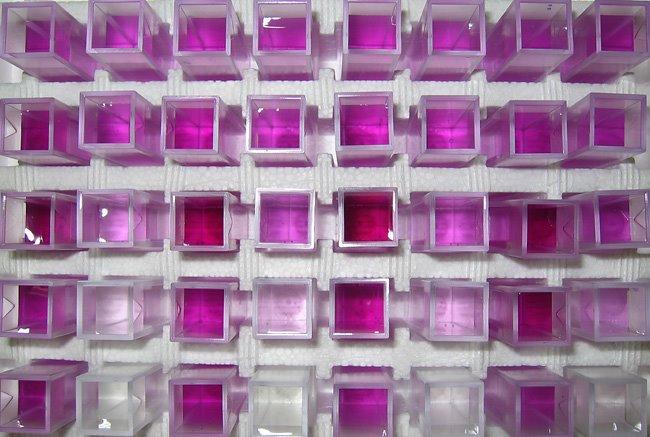
Color Patterns of an Iron Extraction Time Series, Andrew Altevogt, Department of Civil and Environmental Engineering
More about the Art of Science competition.
Thursday, June 08, 2006
Technology in Geologic Time...
I have a copy of my Geology MS thesis on a 5" floppy disk, which I carefully copied and coddled while I wrote (and rewrote and wrote and rewrote) my masterpiece. Now I might as well use it as a coaster for my double half-caf skinny latte. The era of the 31/2 disk is also well and truly over, I'm told. Are CDs and flash drives far behind? So if every new technology is doomed from its inception, how do we preserve our data for future scholars, or even for our own future projects? This concern is raised in stlq, one of my favorite blogs. Fortunately, UMass is working on a solution-- a digital repository, tentatively named UMass Scholarly Commons. For examples of other universities' digital repositories, look here. Aside from the important issue of preservation, there are other opportunities associated with this project--open access journals, for example. If you have questions, or want to become an early adopter of this technology at UMass, contact Marilyn Billings in the Library.
Monday, June 05, 2006
The impact of impact; and, peer review reexamined
Following up on Maxine's post about impact in physics....
A couple of interesting items regarding scholarly publishing have been making their way across the wires today.
(1) ACRLog points to some recent discussions about journal impact factors, including a Wall Street Journal article that discusses impact factor inflation and a Chronicle of Higher Education article (subscription required; UMass users can follow link) on problems quantifying impact in the humanities.
(2) Nature is hosting a web focus, including an online debate, regarding peer review in the scientific publication process:
These are issues that are definitely on people's minds here at UMass Amherst, as the campus undergoes a research benchmarking process and begins to explore the creation of an institutional repository.
A couple of interesting items regarding scholarly publishing have been making their way across the wires today.
(1) ACRLog points to some recent discussions about journal impact factors, including a Wall Street Journal article that discusses impact factor inflation and a Chronicle of Higher Education article (subscription required; UMass users can follow link) on problems quantifying impact in the humanities.
(2) Nature is hosting a web focus, including an online debate, regarding peer review in the scientific publication process:
Peer review is commonly accepted as an essential part of scientific publication. But the ways peer review is put into practice vary across journals and disciplines. What is the best method of peer review? Is it truly a value-adding process? What are the ethical concerns? And how can new technology be used to improve traditional models?(via Science Library Pad)
These are issues that are definitely on people's minds here at UMass Amherst, as the campus undergoes a research benchmarking process and begins to explore the creation of an institutional repository.
Monday, May 22, 2006
Physics is Hot!
Read the story here.
I found this on another blog, From Your Science Librarian's Desk , and thought it might interest people. What do you think of this characterization of research, and what do you think is behind it? I wonder about the effect of this kind of measurement of on the future of scientific learning.
I found this on another blog, From Your Science Librarian's Desk , and thought it might interest people. What do you think of this characterization of research, and what do you think is behind it? I wonder about the effect of this kind of measurement of on the future of scientific learning.
Tuesday, April 18, 2006
Undergraduate writing in the sciences: three nice examples
In working with a few of the junior year writing classes in the sciences here at UMass Amherst, I've been impressed with some of the creative assignments instructors are using to engage students in the process of scholarly research and writing.
Recently, I've come across a few other examples of innovative scientific/scholarly writing projects for undergraduates, which I'd like to share here.
First, from the University of Michigan's Museum of Zoology comes Animal Diversity Web, "an online database of animal natural history, distribution, classification, and conservation biology." Many of the species articles in Animal Diversity Web are written by undergraduates, and articles go through an editing and peer review process. From their website:
Finally, the University of Wisconsin-Madison is launching a student-run, peer-reviewed journal, the Wisconsin Undergraduate Journal of Science. The creation of the journal strives to meet the following goals (from their "About" page):
* To integrate peer-reviewed writing into the undergraduate science curriculum
* To assist students in finding research opportunities both on and off campus
* To allow students to be directly involved in the publishing process
If you or your department is involved in an innovative project to introduce undergraduates to writing in the sciences, feel free to leave a comment below!
Recently, I've come across a few other examples of innovative scientific/scholarly writing projects for undergraduates, which I'd like to share here.
First, from the University of Michigan's Museum of Zoology comes Animal Diversity Web, "an online database of animal natural history, distribution, classification, and conservation biology." Many of the species articles in Animal Diversity Web are written by undergraduates, and articles go through an editing and peer review process. From their website:
An essential feature of the ADW is student authorship of species accounts. Students learn considerable detail about the biology of a species, then share their work with users worldwide by making it part of our permanent database...Instructors and ADW staff review and edit accounts before they are added to the site. Classes at a number of universities contribute to the ADW project, and the resulting growth of the database makes us even better for inquiry learning.Secondly, I saw a great presentation at this year's NERCOMP conference that described a collaborative writing project in the sciences at Vassar College. A professor teamed with educational technologists, a science librarian, and a writing center staffer to create an assignment whereby teams of students collaboratively wrote scientific review articles on topics in protein chemistry. The presentation focused on both the pedagogical and technological aspects of the project--students used an open-source content management system called Plone as a platform for collaborative writing and bibliography assembly. The end result was a series of very impressive scholarly review articles on topics including the pharmacogenetics of HIV/AIDS, chemical biology and cell cycle control, the metabolomics of mad cow disease, and proteomics and Vioxx.
Finally, the University of Wisconsin-Madison is launching a student-run, peer-reviewed journal, the Wisconsin Undergraduate Journal of Science. The creation of the journal strives to meet the following goals (from their "About" page):
* To integrate peer-reviewed writing into the undergraduate science curriculum
* To assist students in finding research opportunities both on and off campus
* To allow students to be directly involved in the publishing process
If you or your department is involved in an innovative project to introduce undergraduates to writing in the sciences, feel free to leave a comment below!
Wednesday, April 12, 2006
Microsoft launches academic search engine
Today, Microsoft launched a search engine devoted to scholarly, academic publications. Dubbed "Windows Live Academic," the search engine (still in beta) so far indexes content in the areas of computer science, physics, electrical engineering, and related areas.
Comparisons are already being drawn with Google Scholar, another major initiative by a search company aimed at indexing scholarly literature. (UMass Amherst has partnered with Google Scholar to make materials that we license accessible to our users. Microsoft will be working with libraries in the weeks to come to achieve something similar.)
Microsoft is fairly explicit about which content they are indexing.
Windows Live Academic is still brand new, and it will be interested to see how it is received by the academic community in the days to come. If you have any questions or comments, feel free to leave a comment on this post or contact the library.
Comparisons are already being drawn with Google Scholar, another major initiative by a search company aimed at indexing scholarly literature. (UMass Amherst has partnered with Google Scholar to make materials that we license accessible to our users. Microsoft will be working with libraries in the weeks to come to achieve something similar.)
Microsoft is fairly explicit about which content they are indexing.
Windows Live Academic is still brand new, and it will be interested to see how it is received by the academic community in the days to come. If you have any questions or comments, feel free to leave a comment on this post or contact the library.
Sunday, April 09, 2006
Happy National Poetry Month, Scientists!
April is National Poetry Month, and let it never be said that science and poetry are incompatible. Here are two instances of the intersection of poetry and science:
Fibs: poetry based on the Fibonacci sequence, a famous mathematical series (via Slashdot)
The Periodic Table of Poetry: click on an element to read a poem about it. Poems contributed by readers! Feeling inspired? There are several elements that still don't have poems.
(As I write this, I notice that my colleage Stephanie Willen Brown, aka CogSci Librarian, has just posted links to some poetry podcasts.)
Enjoy....
Fibs: poetry based on the Fibonacci sequence, a famous mathematical series (via Slashdot)
The Periodic Table of Poetry: click on an element to read a poem about it. Poems contributed by readers! Feeling inspired? There are several elements that still don't have poems.
(As I write this, I notice that my colleage Stephanie Willen Brown, aka CogSci Librarian, has just posted links to some poetry podcasts.)
Enjoy....
Sunday, April 02, 2006
UMass faculty: Your input requested
Faculty members: If you can spare a few moments, please fill out the following survey on the possible creation of a digital repository here at UMass.
The deadline for the survey is Friday, April 7.
http://www.library.umass.edu/forms/insfacrepository.html
If you have questions or comments about the proposed digital repository, please contact Marilyn Billings at mbillings@library.umass.edu or (413) 545-6891.
Thank you!
The deadline for the survey is Friday, April 7.
http://www.library.umass.edu/forms/insfacrepository.html
If you have questions or comments about the proposed digital repository, please contact Marilyn Billings at mbillings@library.umass.edu or (413) 545-6891.
Thank you!
Monday, March 27, 2006
Attention, all SciFinder Scholar users.....
If you use SciFinder Scholar on your own computer, take note! As of April 1, all users must upgrade to the most recent SciFinder Scholar release (downloadable from the library's SciFinder Scholar web page). More information is available over at the Chemistry blog. Questions? Please contact dbhelp@library.umass.edu.
Get all your ISEL news in one feed....
As astute readers may know, in addition to this main blog (ISEL Update), we also have blogs for several of the individual departments that ISEL supports (links are in the right-hand sidebar of this blog). As of this writing, Biochemistry, Chemistry, Engineering, Math & Statistics, Microbiology, Physics, and Veterinary & Animal Science have their own ISEL blogs containing news about information sources in those disciplines.
If you'd like to get updates from ALL ISEL blogs in one feed, rather than subscribing to them individually, you can now do so by subscribing to the following feed:
http://www.rssmix.com/u/10345/rss.xml
This uber-feed was created using a free tool called RSS Mix. RSS Mix lets you roll any number of individual RSS feeds together into one feed, which you can then subscribe to. Very handy!
We'll be adding blogs for more departments as time goes on...watch this space!
If you'd like to get updates from ALL ISEL blogs in one feed, rather than subscribing to them individually, you can now do so by subscribing to the following feed:
http://www.rssmix.com/u/10345/rss.xml
This uber-feed was created using a free tool called RSS Mix. RSS Mix lets you roll any number of individual RSS feeds together into one feed, which you can then subscribe to. Very handy!
We'll be adding blogs for more departments as time goes on...watch this space!
Tuesday, March 21, 2006
Web of Science's Science Citation Index now goes back to 1900
Recently, the UMass Amherst Library sent out a press release to announce new electronic resources. Here is one item, particularly pertinent to researchers in the sciences:
- Web of Science’s Century of Science makes available 850,000 older, twentieth century scientific journal items in one place for the first time from 262 journals. This comprehensive collection is fully searchable, with complete bibliographic data, cited reference data and navigation, and direct links to the full text. Century of Science provides comprehensive backfile and cited reference data from 1900 to 1944. This important tool allows researchers to discover which articles were highly cited during that time period, what journals they were published in, and trace a topic through over one hundred years of research literature.
This is actually just the extension of our Science Citation Index subscription back to 1900, a great thing, but not a separate title. So now you can find out that Albert Einstein's 1935 article in Physical Review, v. 47, no. 10, p.777-780, has been cited at least 2,698 times, and by whom!
Wednesday, March 15, 2006
Maxine Schmidt, new librarian at ISEL
Maxine Schmidt has joined the ranks of librarians at the Integrated Sciences and Engineering Library at UMass Amherst, and we are very happy to have her. Maxine came to librarianship later than many, having earned a BA and MS in Geology at UMass, then going on to work in the public sector in environmental health. She completed her MLIS from Simmons College in May 2005. Welcome, Maxine!
Tuesday, March 07, 2006
Benchmarking Workshops in March
Update 3/8/06: All workshops are now open to all departments--no more separate sessions for sciences vs. social sciences/humanities! Also, 3 dates have been added--see below.
Anyone who will be involved with gathering benchmarking data for academic departments here at UMass Amherst is invited to attend one of several workshops in March sponsored by the UMass Libraries. Workshops will be held on:
March 13 11:00 am at the Science Library, 2nd Floor, Lederle Low Rise
March 14 3:00 pm in the Du Bois Library Room 1620
March 15 Noon in the Du Bois Library Room 1620
March 16 2:00 at the Science Library, 2nd Floor, Lederle Low Rise
March 27 Noon in the Du Bois Library Room 1620
Sessions will cover: how to efficiently and effectively gather faculty publication data for your own department as well as your benchmark institutions. Different sources and strategies can be employed to make this process as quick and painless as possible! Librarians Emily Alling and Steve McGinty will demonstrate some searching techniques using databases like Thomson/ISI's Web of Science and other discipline-specific resources.
Bring your department's indicators & benchmark institutions--there will be opportunities for hands-on practice and individual consultations. Follow-up appointments are also possible.
Please contact Emily Alling (ealling@library.umass.edu; 413-545-6740) or Steve McGinty (smcginty@library.umass.edu; 413-545-1871) for more information.
Anyone who will be involved with gathering benchmarking data for academic departments here at UMass Amherst is invited to attend one of several workshops in March sponsored by the UMass Libraries. Workshops will be held on:
March 13 11:00 am at the Science Library, 2nd Floor, Lederle Low Rise
March 14 3:00 pm in the Du Bois Library Room 1620
March 15 Noon in the Du Bois Library Room 1620
March 16 2:00 at the Science Library, 2nd Floor, Lederle Low Rise
March 27 Noon in the Du Bois Library Room 1620
Sessions will cover: how to efficiently and effectively gather faculty publication data for your own department as well as your benchmark institutions. Different sources and strategies can be employed to make this process as quick and painless as possible! Librarians Emily Alling and Steve McGinty will demonstrate some searching techniques using databases like Thomson/ISI's Web of Science and other discipline-specific resources.
Bring your department's indicators & benchmark institutions--there will be opportunities for hands-on practice and individual consultations. Follow-up appointments are also possible.
Please contact Emily Alling (ealling@library.umass.edu; 413-545-6740) or Steve McGinty (smcginty@library.umass.edu; 413-545-1871) for more information.
UMass Libraries' Fourth Annual Dinner with Friends
On Saturday, April 1, 2006, at 6:30 p.m., the Friends of the UMass Amherst Library will host the fourth annual "Dinner with Friends" in the new Learning Commons at the W.E.B. Du Bois Library on the UMass Amherst campus
The event features three notable authors from the area-Norton Juster, Sabina Murray, and Ilan Stavans, a champagne and hors d'oeuvre reception with Celtic harpist Sarah McKee, and a gourmet feast. Tickets are $125 per person or $200 for two (of which $90 is tax-deductible, $130 for two).
Last year, attendees and sponsors raised over $16,000 for the Library. This year, all proceeds will benefit the expansion of the Learning Commons.
View invitation flyer (PDF).
For more information, contact Emily Silverman at the UMass Amherst
Library at (413) 545-0995 or email friends@library.umass.edu.
The event features three notable authors from the area-Norton Juster, Sabina Murray, and Ilan Stavans, a champagne and hors d'oeuvre reception with Celtic harpist Sarah McKee, and a gourmet feast. Tickets are $125 per person or $200 for two (of which $90 is tax-deductible, $130 for two).
Last year, attendees and sponsors raised over $16,000 for the Library. This year, all proceeds will benefit the expansion of the Learning Commons.
View invitation flyer (PDF).
For more information, contact Emily Silverman at the UMass Amherst
Library at (413) 545-0995 or email friends@library.umass.edu.
Thursday, February 23, 2006
Trial sub for ISI Proceedings
The UMass Amherst Libraries have a trial subscription to ISI Proceedings, a database of articles published in "more than 60,000 conferences" in two segments which can be searched simultaneously, Science & Technology (STP) Database and Social Sciences & Humanities (SSHP) Database. The date range goes back to 1990 for both segments.
ISI Proceedings is a product of the same company that brings us Web of Science, the combined citation indexes (Science Citation Index, Social Science Citation Index, Arts and Humanities Citation Index). But ISI Proceedings' records do not include "Times Cited" information. They do include the references cited in each paper, and where those cited articles are journal articles included in the Web of Science database, they are linked to their records in WoS.
According to their database description, ISI Proceedings includes items from the following sources:
ISI Proceedings is a product of the same company that brings us Web of Science, the combined citation indexes (Science Citation Index, Social Science Citation Index, Arts and Humanities Citation Index). But ISI Proceedings' records do not include "Times Cited" information. They do include the references cited in each paper, and where those cited articles are journal articles included in the Web of Science database, they are linked to their records in WoS.
According to their database description, ISI Proceedings includes items from the following sources:
- Books
- Journals
- Reports
- Series produced by publishers or societies
- Sets of preprints (when preprints are the only publications from a conference)
- International proceedings (includes papers published in English and other languages)
If you have any questions about the database or the trial, please contact one of the ISEL librarians at 545-1370, or email Naka Ishii.
Monday, February 06, 2006
"Pity the Scientist who Discovers the Discovered"
An article in today's New York Times (registration required) discusses scientists who publish research that's....already been published. By others. Sometimes more than once. The problem? Poorly constructed or lacking literature searches! Don't let this happen to you! Librarians can help!
Thursday, February 02, 2006
National Academies report on maintaining science & technology competitiveness in the 21st century
The National Academies was asked by Senators Lamar Alexander and Jeff Bingaman to respond to the following questions:
What are the top 10 actions, in priority order, that federal policy-makers could take to enhance the science and technology enterprise so that the United States can successfully compete, prosper, and be secure in the global community of the 21st Century? What strategy, with several concrete steps, could be used to implement each of those actions?A diverse commission of 20 people was convened to address these questions, and the resulting report, Rising Above the Gathering Storm; Energizing and Employing America for a Brighter Economic Future,has been published by The National Academies, and is available on their Website for reading online, downloading or purchase. From the description:
This report has already been incorporated into legislation entitled PACE (Protect America's Competitive Edge) and this promises to be wide-ranging in its effects. It remains to be seen whether execution will match inception.In a world where advanced knowledge is widespread and low-cost labor is readily available, U.S. advantages in the marketplace and in science and technology have begun to erode. A comprehensive and coordinated federal effort is urgently needed to bolster U.S. competitiveness and pre-eminence in these areas. This congressionally requested report by a pre-eminent committee makes four recommendations along with 20 implementation actions that federal policy-makers should take to create high-quality jobs and focus new science and technology efforts on meeting the nation's needs, especially in the area of clean, affordable energy:
1) Increase America's talent pool by vastly improving K-12 mathematics and science education;
2) Sustain and strengthen the nation's commitment to long-term basic research;
3) Develop, recruit, and retain top students, scientists, and engineers from both the U.S. and abroad; and
4) Ensure that the United States is the premier place in the world for innovation.
Some actions will involve changing existing laws, while others will require financial support that would come from reallocating existing budgets or increasing them.
Easier access to Chronicle at UMass Amherst
Good news for UMass Amherst readers of the Chronicle of Higher Education: You can now access the Chronicle online without needing to enter a username or password. As with most of our other ejournals, you should be able to get right in and read articles in the Chronicle from any computer with a UMass Amherst IP address (i.e., on campus or through OIT dialup).
If you'd like to read the Chronicle from off campus, be sure to go through the UMass Amherst library catalog to access it. You'll be prompted to enter your OIT username and password. (If you just type "chronicle.com" into your browser, you won't be recognized as coming from UMass and you won't have access to subscriber-only content.) Once you log in, you should have full access to all online Chronicle content.
Any RSS users (Bloglines, My Yahoo!, FeedDemon, etc.) out there may also be interested in subscribing to one of the Chronicle's RSS feeds. They offer a daily news feed, a "Wired Campus Blog," and career feeds for dozens of job categories.
We hope you enjoy this easier access. If you have any questions or problems, please contact the library--we'd be happy to try to help.
If you'd like to read the Chronicle from off campus, be sure to go through the UMass Amherst library catalog to access it. You'll be prompted to enter your OIT username and password. (If you just type "chronicle.com" into your browser, you won't be recognized as coming from UMass and you won't have access to subscriber-only content.) Once you log in, you should have full access to all online Chronicle content.
Any RSS users (Bloglines, My Yahoo!, FeedDemon, etc.) out there may also be interested in subscribing to one of the Chronicle's RSS feeds. They offer a daily news feed, a "Wired Campus Blog," and career feeds for dozens of job categories.
We hope you enjoy this easier access. If you have any questions or problems, please contact the library--we'd be happy to try to help.
Thursday, January 19, 2006
Send us your book requests!
The library would like to know what books you'd like us to buy in your subject areas. Now is a great time to send in those requests as we spend up the 2005-2006 book budget. Contact your library liaison (see list of liaisons by department) with any recommendations.
Tuesday, January 10, 2006
Online catalog downtime Friday 1/13/06, 5:00-9:00 pm
The UMass online library catalog will be unavailable on Friday, January 13 starting at 5 pm and lasting a few hours. This is to repair a server. Apologies for any inconvenience.
Wednesday, January 04, 2006
UMLinks/E-journal locator down Sat. 1/7
This Saturday (Jan. 7) beginning at 7:00 am, the UMLinks article linking service and our e-journal locator will be unavailable for several hours as we switch servers.
Apologies for any inconvenience....hopefully, this changeover will result in the improved performance & reliability of these services!
Apologies for any inconvenience....hopefully, this changeover will result in the improved performance & reliability of these services!
Thursday, December 29, 2005
Intersession @ ISEL
It's mighty quiet here at ISEL this week--a good time to come by & get some research done without battling the hordes! Here are our hours for the rest of 2005 and for January Term:
Tues. Dec 27 - Fri. Dec. 30: 8:00 am - 5:00 pm
Sat. Dec 31-Mon. Jan 2: CLOSED
During January Term (Jan. 3 - Jan. 29), we'll be open M-F, 8:00 am - 5:00 pm and closed on weekends.
Full hours are always available on the library website.
Happy New Year!
Tues. Dec 27 - Fri. Dec. 30: 8:00 am - 5:00 pm
Sat. Dec 31-Mon. Jan 2: CLOSED
During January Term (Jan. 3 - Jan. 29), we'll be open M-F, 8:00 am - 5:00 pm and closed on weekends.
Full hours are always available on the library website.
Happy New Year!
Thursday, December 15, 2005
Journal Citation Reports now available to UMass community
The library is now able to make access to ISI's powerful Journal Citation Reports available to all current UMass faculty, staff, and students. To access JCR, just visit the library's homepage, choose Databases, navigate to J, and click Journal Citation Reports.
JCR provides crucial information about journal titles indexed by ISI: impact factor (the average number of times articles from the journal published in the past two years have been cited in the JCR year); immediacy index (the average number of times an article is cited in the year it is published); cited half-life (the median age of the articles that were cited in the JCR year), and more.
It's also possible to generate lists of the journals in a particular discipline that have the highest impact factors, immediacy indexes, etc. (In fact, I'm spending my evening at the ref. desk reviewing the library's holdings for the highest-impact journals in each of my liaison departments. So far, we're doing pretty well!)
If you have any questions at all about using JCR or any other library resource, feel free to contact me.
JCR provides crucial information about journal titles indexed by ISI: impact factor (the average number of times articles from the journal published in the past two years have been cited in the JCR year); immediacy index (the average number of times an article is cited in the year it is published); cited half-life (the median age of the articles that were cited in the JCR year), and more.
It's also possible to generate lists of the journals in a particular discipline that have the highest impact factors, immediacy indexes, etc. (In fact, I'm spending my evening at the ref. desk reviewing the library's holdings for the highest-impact journals in each of my liaison departments. So far, we're doing pretty well!)
If you have any questions at all about using JCR or any other library resource, feel free to contact me.
Monday, December 12, 2005
Recommended journals for freshman science majors?
There's an interesting discussion going on on CHMINF-L about science periodicals that are appropriate to recommend to freshmen/lower division undergraduates as a means of keeping current and becoming familiar with their fields. The importance of critically evaluating information and distinguishing between popular and news sources vs. scholarly, peer-reviewed sources has come up more than once, as well.
Here are the titles that have been brought up so far.
Have anything to add? Reactions to any titles on the list? Feel free to leave a comment below.
Incidentally, more and more science magazines and journals are offering a weekly podcast, or audio recording, summarizing highlights of the current week's issue. Nature, New England Journal of Medicine, and New Scientist are just a few of these. Maybe something our iPod generation would be quick to latch onto?
Here are the titles that have been brought up so far.
- American Scientist
- Astronomy
- BioScience
- Chemical &Engineering News
- Environment
- JAMA
- Natural History
- Nature
- New England Journal of Medicine
- New Scientist
- Physics Today
- Science
- Science News
- Scientific American
- Sky and Telescope
Have anything to add? Reactions to any titles on the list? Feel free to leave a comment below.
Incidentally, more and more science magazines and journals are offering a weekly podcast, or audio recording, summarizing highlights of the current week's issue. Nature, New England Journal of Medicine, and New Scientist are just a few of these. Maybe something our iPod generation would be quick to latch onto?
Tuesday, December 06, 2005
Nature blogs! and science in the Web age
Nature Publishing Group has launched three new blogs:
Action Potential
Free Association
Nascent
Action Potential
Action Potential is a blog by the editors of Nature Neuroscience - and a forum for our readers, authors and the entire neuroscience community. We'll discuss what's new and exciting in neuroscience, be it in our journal or elsewhere. We hope for spirited conversation!
Free Association
Welcome to Free Association, the Nature Genetics blog. Check here regularly for links and editorial comment on research and news in genetics, as well as reader feedback.
Nascent
Nature Publishing Group's blog on web technology and science.Nascent points to an editorial and series of articles from this week's Nature that discuss issues involved with doing science and sharing data in the Web age. (UMass users can access the full text of Nature by going through the library catalog.)
Putting science to song in the classroom
Wired Magazine recently ran an article on Greg Crowther, a lecturer at the University of Washington who has set some of the concepts he teaches to music and sings them to his students (to mixed appreciation). Songs include takes on the Archies ("Glucose / ah, sugar sugar / You are my favorite fuel / from the bloodborne substrate pool"), Talking Heads ("Take Me to the Liver," about cholesterol metabolism), and Andrew Lloyd Webber ("The Phantom of the Copper Coil").
Many more song titles, with lyrics, can be viewed at Crowther's personal homepage. Crowther also makes MP3 downloads and sheet music available for some titles. And, if those don't satiate your appetite for science songs, Crowther also maintains an online database of over 2000 science-related songs called MASSIVE.
Many more song titles, with lyrics, can be viewed at Crowther's personal homepage. Crowther also makes MP3 downloads and sheet music available for some titles. And, if those don't satiate your appetite for science songs, Crowther also maintains an online database of over 2000 science-related songs called MASSIVE.
Thursday, December 01, 2005
Thomson ISI Web Citation Index
In an exciting development for the open access and repository movement, Thomson Scientific has announced that it is teaming with NEC and several other agencies to create a Web Citation Index, which will become part of the Web of Knowledege platform.
The Web Citation index will do for open access documents, including pre-prints and items in institutional repositories, what Thomson's other citation indexes currently do for peer-reviewed journal literature. Researchers will be able to follow citations to open-access documents backwards and forwards, and citation frequency and trends will be recorded.
More coverage is available from Information World Review and Open Access News.
(via KnowledgeSpeak Newsletter)
The Web Citation index will do for open access documents, including pre-prints and items in institutional repositories, what Thomson's other citation indexes currently do for peer-reviewed journal literature. Researchers will be able to follow citations to open-access documents backwards and forwards, and citation frequency and trends will be recorded.
More coverage is available from Information World Review and Open Access News.
(via KnowledgeSpeak Newsletter)
Tuesday, November 22, 2005
Updates to Web of Science @ UMass Libraries
The content in the UMass Libraries' subscription to Science Citation Index via Web of Science now reaches back through the year 1900, thanks to our purchase of a backfile.
Also, UMass now has access to the MEDLINE database through the Web of Science platform through this academic year, at least. (Our current method of access to MEDLINE has been through the free PubMed database.)
Also, UMass now has access to the MEDLINE database through the Web of Science platform through this academic year, at least. (Our current method of access to MEDLINE has been through the free PubMed database.)
[Microbiology] New e-journal @ UMass Libraries
Microbiologists may be pleased to learn that the UMass libraries now offer the full text of Acta microbiologica et immunologica Hungarica from 1999 to the present. The science library also has this journal in print back to 1994. Enjoy!
--
Posted by Emily Alling to Microbiology at 11/22/2005 09:26:00 AM
--
Posted by Emily Alling to Microbiology at 11/22/2005 09:26:00 AM
[Chemistry] Chmoogle and ChemDB: free chemical information
This week saw the announcement of a new free chemistry information database: Chmoogle, by eMolecules Inc.
From their mission statement:
In comparison, ChemDB, a new public database of small molecules based at UC Irvine, provides the following about their sources:
Both of these new tools are certainly interesting in light of the recent discussions about open access to chemical data (cf. ACS, PubChem, etc.). I'd be interested to hear any chemists' reviews of Chmoogle and/or ChemDB...feel free to leave a comment below.
From their mission statement:
Chmoogle® is the leading open-access chemistry search engine. Chmoogle's mission is to discover, curate and index all of the public chemical information in the world, and make it available to the public for free. Chmoogle distinguishes itself by extremely fast searches, an appealing presentation of results, high-quality chemical drawings, and powerful advanced search capabilities like persistent hitlists and hitlist logic operations.My librarian warning light went off a little at this item from their FAQ:
What are Chmoogle's sources?A little more specificity would be nice ("the internet" is a tad bit broad).
Chmoogle discovers sources of chemical data by searching the internet, and receives submissions from data providers such as chemical suppliers and academic researchers.
In comparison, ChemDB, a new public database of small molecules based at UC Irvine, provides the following about their sources:
Chemical Vendors: All of the vendors who have supplied their chemical information catalogs that comprise the core data beneath ChemDB. The source information table includes a complete listing.You can read more about the creation of ChemDB in this article, which has been accepted for publication in Bioinformatics.
Both of these new tools are certainly interesting in light of the recent discussions about open access to chemical data (cf. ACS, PubChem, etc.). I'd be interested to hear any chemists' reviews of Chmoogle and/or ChemDB...feel free to leave a comment below.
Thursday, November 17, 2005
ISEL Thanksgiving Week Hours
In addition to the normal Thanksgiving Week hours changes, there's been an additional change. ISEL will now be closed on Friday, November 25 due to an electrical upgrade in the Lederle Graduate Research Center. So, our hours changes for the week are:
Normal hours resume on Sunday, November 27.
Have a wonderful break!
- Wednesday, November 23: 8 am - 5 pm
- Thursday, November 24: CLOSED
- Friday, November 25: CLOSED
- Saturday, November 26: CLOSED
Normal hours resume on Sunday, November 27.
Have a wonderful break!
Tuesday, November 15, 2005
SciFinder Scholar for Mac OS X now available!
Mac users who have been pining away for a native OS X version of SciFinder Scholar, your day has come! The download is available from the UMass Amherst Libraries' SciFinder page; just scroll down to "SciFinder Scholar for Mac OS X (10.2, 10.3 and 10.4)."
Please note that our license will only permit this software to be downloaded or used by on a computer with a UMass IP address. This means that you must be on campus or connected through a dial-up OIT connection in order to download or use SciFinder Scholar.
Enjoy!
Please note that our license will only permit this software to be downloaded or used by on a computer with a UMass IP address. This means that you must be on campus or connected through a dial-up OIT connection in order to download or use SciFinder Scholar.
Enjoy!
Learning Commons 24/5 starts 11/27/05
Stay up late at the (other) library! The Learning Commons at the W.E.B. Du Bois Library will start its 24/5 schedule on Sunday, November 27. The library will open at 11 am on Sundays and remain open 24 hours per day until 9 pm on Fridays. The library will open from 9 am to 9 pm on Saturdays.
The Procrasination Station (library cafe) will also feature expanded hours.
Be sure to check the libraries' Hours page for exceptions to normal operating hours, including the upcoming Thanksgiving holiday.
The Procrasination Station (library cafe) will also feature expanded hours.
Be sure to check the libraries' Hours page for exceptions to normal operating hours, including the upcoming Thanksgiving holiday.
Monday, November 14, 2005
Reasons *not* to reshelve....
You may have noticed signs in the library asking people not to reshelve books and journals after using them, but rather to leave them on a cart, or by the copier. Lots of people assume this is because we don't trust you to put things back in the proper order. While the Library of Congress call number system can indeed be a deep mystery to the uninitiated, there is actually a second and more crucial reason why we ask that you leave materials for us to reshelve.
Before we reshelve library materials left for us by our users, the library scans each item to indicate that it has been used. This usage data helps inform us when making decisions about whether to renew or cancel materials, or buy more items in a given subject area. (See, for example, the library's current review of journal titles costing more than $1000 per year.) So, *not* reshelving your favorite book or journal is actually a way of letting us know that it's important to you.
We pick up, scan, and reshelve materials at ISEL several times per day. If you ever have trouble locating an item in the library, please come see us at the Circulation or Reference Desks. We are often able to locate materials that seem hopelessly lost (another one of those great library mysteries).
Before we reshelve library materials left for us by our users, the library scans each item to indicate that it has been used. This usage data helps inform us when making decisions about whether to renew or cancel materials, or buy more items in a given subject area. (See, for example, the library's current review of journal titles costing more than $1000 per year.) So, *not* reshelving your favorite book or journal is actually a way of letting us know that it's important to you.
We pick up, scan, and reshelve materials at ISEL several times per day. If you ever have trouble locating an item in the library, please come see us at the Circulation or Reference Desks. We are often able to locate materials that seem hopelessly lost (another one of those great library mysteries).
Wednesday, November 09, 2005
Anyone have the Feb. '05 Scientific American?
ISEL never received our February 2005 issue of Scientific American, and we aren't able to get it from the publisher at this point. If anyone out there with a personal subscription to SciAm still has the February issue and wouldn't mind donating it to the Science Library, we'd be forever in your debt. Please contact John Caranci--caranci@library.umass.edu--if you can help.
Tuesday, November 08, 2005
[Biochemistry] Clinical Biochemist Reviews now available via PubMed Central
Clinical Biochemist Reviews has been added to the PubMed Central archive from v. 26 no. 1 (2005) to the present.
--
Posted by Emily Alling to Biochemistry at 11/08/2005 10:49:00 AM
--
Posted by Emily Alling to Biochemistry at 11/08/2005 10:49:00 AM
IEEE downtime, 11/15/05
From a recent email to the UMass libraries from IEEE:
On Tuesday, 15 November, IEEE will implement a maintenance release to the IEEE Xplore digital library.
As a result, users will experience approximately two hours of downtime on that date, between 10AM and 12Noon EST.
This update includes the following features:
* RSS feeds for newly published journal tables of contents.
* Non-indexed materials, such as editorials and book reviews, will now be available, free, to all users.
Thursday, November 03, 2005
Journal review @ UMass libraries
The UMass Amherst libraries are undertaking a review of journal subscriptions that cost $1000 or more per year yet receive very little use. We are hoping to redirect the money spent on these journals toward resources that would be more useful to our patrons, such as journal titles that are frequently requested via Interlibrary Loan or other journals and databases that have been requested by our users.
Letters have been sent to the heads of all departments on campus to let them know about this review process, which has been endorsed by the Research Library Council.
It is important to note that this is not a journal cancellation project per se--money saved by cancelling little-used journals will be reallocated to other resources.
See the libraries' recent press release for much more information. Included is the list of journals being considered for cancellation--that is, those titles costing $1000 or more which have received 3 or fewer uses in the past year.
The sciences are quite heavily represented in this list. If you have any questions, concerns, or suggestions, please contact me anytime.
Letters have been sent to the heads of all departments on campus to let them know about this review process, which has been endorsed by the Research Library Council.
It is important to note that this is not a journal cancellation project per se--money saved by cancelling little-used journals will be reallocated to other resources.
See the libraries' recent press release for much more information. Included is the list of journals being considered for cancellation--that is, those titles costing $1000 or more which have received 3 or fewer uses in the past year.
The sciences are quite heavily represented in this list. If you have any questions, concerns, or suggestions, please contact me anytime.
Wednesday, November 02, 2005
Science News Podcasts
There's a thread going on on Slashdot about science news podcasts....If you're looking to fill up your iPod or other MP3-playing device, you may wish to check it out. Some highlights: Nature is podcasting, and New Scientist is about to start.
More about podcasting (from Wikipedia).
More about podcasting (from Wikipedia).
[Chemistry] RSS Feeds to ACS Publications
You can now get tables of contents from several ACS journals delivered via RSS. Here are links to the feeds for participating journals:
Analytical Chemistry A
Environmental Science & Technology A Page Magazine
Environmental Science & Technology Online News
Journal of Proteome Research
Chemical & Engineering News Online
But wait--what am I seeing when I click on these links? Confused? These aren't links to actual content from the journal--rather, they are links you can use to subscribe to journal updates using your RSS reader of choice. You need to copy and paste these links into your RSS reader to subscribe. Popular RSS feed readers include Bloglines and MyYahoo.
Still confused? Let me know--in addition to being a science reference librarian, I'm increasingly becoming an RSS evangelist, and would be happy to help you get set up with an account.
via ACS Livewire
--
Posted by era to Chemistry at 11/02/2005 06:49:00 AM
Analytical Chemistry A
Environmental Science & Technology A Page Magazine
Environmental Science & Technology Online News
Journal of Proteome Research
Chemical & Engineering News Online
But wait--what am I seeing when I click on these links? Confused? These aren't links to actual content from the journal--rather, they are links you can use to subscribe to journal updates using your RSS reader of choice. You need to copy and paste these links into your RSS reader to subscribe. Popular RSS feed readers include Bloglines and MyYahoo.
Still confused? Let me know--in addition to being a science reference librarian, I'm increasingly becoming an RSS evangelist, and would be happy to help you get set up with an account.
via ACS Livewire
--
Posted by era to Chemistry at 11/02/2005 06:49:00 AM
Academic integrity in the news
Academic integrity is in the headlines these days, both on campus and in the world beyond. MIT associate professor of biology Luk Van Parijs was fired last week after admitting to falsifying data on several occasions. Ripple effects from this announcement have included an announcement from Cell Press, publishers of the journal Immunity, that they are in the process of re-examining the accuracy of three of Van Parijs' articles published in 1998-1999.
Closer to home, the Faculty Senate has taken up the issue of plagiarism on campus and is considering creating an ad hoc committee to deal with student plagiarism. One option being explored on campus is the use of plagiarism detection software. Since last spring, the library has been sponsoring a trial of TurnItIn.com, a Web-based service that allows professors to check student work against a database of documents including the public Web, content from several proprietary full-text article databases, and a huge compliation of student paper submissions. The issue of plagiarism and TurnItIn has received some media attention, including a 10/24/05 appearance on WFCR by Library Associate Director for User Services Anne C. Moore and coverage in the Daily Collegian.
The use of TurnItIn on college campuses has not been without controversy. In one high-profile lawsuit, a McGill University student successfully challenged the practice of compelling students to submit their papers to TurnItIn, arguing that the company was profiting by building a database in part from students' [copyrighted] original work. Others have objected that the use of tools like TurnItIn creates a negative climate by implicitly assuming students are guilty of plagiarism until proven innocent. It should be noted that both false negatives *and* false positives are possible with any automated plagiarism detection device.
Some of these concerns were addressed by Anne C. Moore at the faculty senate meeting on October 20. At UMass, the use of TurnItIn would be voluntary for both faculty and students. Moore also emphasized the potential to use TurnItIn not as a punitive tool, but as an educational opportunity to let students know where their work fails to meet academic integrity standards. Many students remain unaware of the gravity of plagiarism and other academic dishonesty; other times, plagiarism results from an unintentional failure to insert a citation; and some students come from cultures where using the exact words of others is considered honorific rather than dishonest. TurnItIn was hailed as one piece of a campus-wide solution to the plagiarism problem, along with [continued] faculty efforts to educate students about academic honesty AND strategies such as designing "plagiarism-proof" assignments.
If you have questions or comments about TurnItIn, please feel free to contact me personally or the library in general. You can also leave a comment on this blog if you have thoughts about academic integrity on campus or beyond.
Closer to home, the Faculty Senate has taken up the issue of plagiarism on campus and is considering creating an ad hoc committee to deal with student plagiarism. One option being explored on campus is the use of plagiarism detection software. Since last spring, the library has been sponsoring a trial of TurnItIn.com, a Web-based service that allows professors to check student work against a database of documents including the public Web, content from several proprietary full-text article databases, and a huge compliation of student paper submissions. The issue of plagiarism and TurnItIn has received some media attention, including a 10/24/05 appearance on WFCR by Library Associate Director for User Services Anne C. Moore and coverage in the Daily Collegian.
The use of TurnItIn on college campuses has not been without controversy. In one high-profile lawsuit, a McGill University student successfully challenged the practice of compelling students to submit their papers to TurnItIn, arguing that the company was profiting by building a database in part from students' [copyrighted] original work. Others have objected that the use of tools like TurnItIn creates a negative climate by implicitly assuming students are guilty of plagiarism until proven innocent. It should be noted that both false negatives *and* false positives are possible with any automated plagiarism detection device.
Some of these concerns were addressed by Anne C. Moore at the faculty senate meeting on October 20. At UMass, the use of TurnItIn would be voluntary for both faculty and students. Moore also emphasized the potential to use TurnItIn not as a punitive tool, but as an educational opportunity to let students know where their work fails to meet academic integrity standards. Many students remain unaware of the gravity of plagiarism and other academic dishonesty; other times, plagiarism results from an unintentional failure to insert a citation; and some students come from cultures where using the exact words of others is considered honorific rather than dishonest. TurnItIn was hailed as one piece of a campus-wide solution to the plagiarism problem, along with [continued] faculty efforts to educate students about academic honesty AND strategies such as designing "plagiarism-proof" assignments.
If you have questions or comments about TurnItIn, please feel free to contact me personally or the library in general. You can also leave a comment on this blog if you have thoughts about academic integrity on campus or beyond.
Tuesday, November 01, 2005
Biology/genetics dashboard widgets for Mac OS X
Any biologists out there using Mac OS 10.4 (Tiger) might be interested in these dashboard widgets from AbOrygen.
# The Amino Acid Table widget displays general information on amino acids (name, 3-letter code, 1-letter code, triplet and standard color code) conformed with the IUPAC-IUB recommendations.Thanks to Science Library Pad.
# The Genetic Code widget displays the standard genetic code in a simple table showing the 64 codons and the amino acids each codon codes for.
# The Nucleic Acid Nomenclature widget displays general information on nucleic acids (symbol, meaning, complement and origin of designation) conformed with the IUPAC-IUB recommendations.
# The Rebase widget provides a quick access to the Restriction Enzyme Database.
Subscribe to:
Posts (Atom)